Sunday, 17 February 2013

Two Cigarettes in the Dark – Tanztheater Wuppertal at Sadler’s Wells

[another occasion where writing is completely unequal and unsuited to the task at hand]


This is the first time I’ve seen a Pina Bausch show in the flesh. It comes four years after her death and 28 years after she made this show. That Thursday night was the British première of Two Cigarettes in the Dark, which was made in West Germany in 1985 only makes me feel slightly better about the whole thing.

Don’t get me wrong, I feel like I’ve seen tonnes of Pina Bausch. I’ve watched Café Müller and Frühlingsopfer over and over on YouTube. I’ve seen the Wim Wenders film. I’ve seen Alain Platel’s Out of Context – For Pina. Hell, I’ve seen enough work by Katie Mitchell and every choreographer Bausch has ever influenced (which often feels like every choreographer) to feel like I hardly stop seeing her work, and yet this is the first time I’ve really seen some of it. And what’s most surprising is how *unlike* “Pina Bausch” a lot of Two Cigarettes in the Dark feels.

For a start, it’s actually a lot funnier than anyone ever talks about. I don’t know the canon of her work well enough to say whether this is a total one-off, in a minority, or whether her work and her reputation has been massively misrepresented by a posterity keen to concentrate on the beauty and tortured-soul stuff, but whatever is it, Two Cigarettes in the Dark is surprisingly wry and absurd to the extent that at times it resembles nothing so much as a choreographic tribute to Monty Python. It also recalls the sort of straight-faced silliness of Marthaler – especially his Meine Faire Dame, which I hadn’t expected.

So, what’s Two Cigarettes in the Dark got? What does it do? Well, it’s set in a very large white room with large windows set into each wall. The window at the back gives onto a bunch of large tropical plants in an adjoining black room. The rooms on either side are white, and led up-to with staircases. There is a row of fishtanks placed against th window on the audience’s left.

There are eleven performers. I think slightly more women than men. Unfussily multi-national, as dance companies tend to be. And mostly middle-aged. Not having seen the piece before, I don’t know if this is because it’s the original company performing the piece 28 years on (cf. Ostermeier’s Crave or that never-ending production of Arturo Ui at the Berliner Ensemble which has outlived its director Heiner Müller by 18 years). I rather suspect that here it was always middle-aged dancers. Bausch, after all, is famous for having worked with a far richer, more varied palette of performers than your bog-standard choreographer. And here, there’s not so very much of yer actual *dancing*.

The piece does start with a frenzied explosion of repeated, compulsive arm flailing as one woman stands downstage rehearsing some sort of outward expression of inner torment. She is dressed in a low-cut beige ballgown. This seems like the sort of trademark Bausch thing that we’re expecting. Then (or was it before this) a portly woman dressed in a kitsch bathrobe wanders to the front of the stage and confides in a loud theatrical whisper that her husband is out. She then waddles the entire length of the stage back to the door at the rear and exits. Which is less expected.

From here the stage is peopled by various ball-gowned or dinner jacketed visions of elegance, or aged elegance, or, in one repeated case, punctured dignity undermined by childish glee and/or senile dementia and eventually with diver’s flippers. There seems to be some repetition of patterns of domestic violence, but this is offset with sweet or amused tableaux – at one point a woman curled on the floor offers her partner a leg to hold in order that her entire body might be lifted up and used to break peanut shells. There is occasional talk of- or movement to suggest- angels.

The use of music is no less intelligent than you’d expect. High-classical choral music – like the Bach used in Café Müller – recurs here, but perhaps with its sheer weightiness used against itself; its sheer over-wroughtness being deftly punctured by the pathos of the scenes it scores. Perhaps a joke by the artist against herself. Perhaps the most remarkable thing is how much, despite a total lack of any discernible narrative, it is possible to just keep watching, amused, entertained, sometimes moved and occasionally baffled for two and a half hours (plus interval).

The evening – well, I was going to say “builds”, but it doesn’t really build, it just arrives – to a frenetic conclusion and then plauteaus out with a solitary performer slumped against a wall spray-painting himself white, with a pair of giant angel wings strapped to his back.

I’d love to be able to suddenly pull and explanation out of the bag, and perhaps 28 years ago, all these symbols *read* a bit more intensely than they do now. One notices, for example, that the piece precedes Wenders’s own effort on angels Der Himmel über Berlin (or Wings of Desire as we have it) by only two years. Perhaps there was something in the West German water back then. But I’m afraid that’s not how I watched it. I was delighted and engrossed, but felt more-or-less entirely let of from having to really pin it down. Watching felt experiential rather than philosophical. I was more intrigued by the “how?” of the dramaturgy than the whys and wherefores. In other circumstances this might be accounted a failure. Here it felt precisely right.
__________

Looking for images for the top of the article, I came across some older ones which, perhaps only because they're in grainy black and white, but I don't think it's just that, suggest the thing used to look a lot edgier...


Saturday, 16 February 2013

Flow - the Print Room


It’s exciting that the Print Room has given over a slot in its programming to a piece of newly commissioned contemporary choreography. Sadly, that’s pretty much where the excitement stops. I don’t deny that there’s a fair amount of talent sloshing around in Flow. The young choreographer Hubert Essakow has an impressively long CV as a ballet dancer, though his choreographic credits are noticeably thinner on the ground. Designer Tom Dixon by contrast has a whole OBE for his services to furniture design and apparently he even launched his own name as “a brand” in 2002. His contribution to Flow is a neatly made sort of Roman iceberg – that is to say, a four-sided, white material structure hung in the middle of the dancefloor that can be raised up into itself and lowered again.

The piece begins. Slowly. With a hippy trapped inside this fabric iceberg, rolling a giant white glowstick around. Very. Slowly (see above). He is dressed in a simple off-white long-sleeve top and loose trousers. I immediately realise that I have a very real prejudice against light clothing and slow movement in dance.

Composer Peter Gregson’s Music is also remarkably bland, consisting of a lot of over-processed piano notes, and (I think) some treated strings, as well as an atmosphere evoking the rain-sticks and pan pipes of a new-age store. It’s slow and mostly sounds like offcuts from Michael Nyman’s soundtrack to The Piano.

Any one of these elements could have been bland – the slow-motion shape-throwing, the set and costume, the sonic backdrop – but all three is too much for my tastes. (And I readily concede this is a taste thing. I’m just not that into dance pieces that aspire to the condition of a scented bath with candles). But I’m not really qualified to talk about dance. The movement is all very proficiently executed.  And you'll have seen it all before, I promise.

Dramaturgy, on the other hand, I do understand. And the dramaturgy here is roughly as developed as one brain-storming session and a resultant spider-diagram. The theme of Flow is “Water”. Essakow’s programme notes sagely observe that on meeting the designer “after a few discussions by the sea we came up with the idea of exploring the cycle of water as a metaphor for the cycle of life. Water is essential to life – it’s everywhere and affects everybody. The three states of water – liquid, ice and vapour – offered good starting points to develop and explore a range of movement ideas.”

I am being slightly unfair. I mean, the thing is completely watchable. It’s simple-minded beyond belief, but the execution itself is pretty (and you could well like the music a good deal more than I did, which would improve your enjoyment about 70%). There is also some rather nice work with a smoke machine (but nothing on that of Fujiko Nakaya in Gisele Vienne’s This is How You Will Disappear), and the – surprisingly brief – section with *actual water!* at the end is also pleasingly exuberant (but, again, nothing on Dave St Pierre’s Un Peu de Tendresse: Bordel de Merde or, I suspect, De La Guarda).

As such, given the limitations of the size of the space (and presumably budget), it strikes me that the piece’s only option for being A Good Thing – beyond the basic excellence of existing in the first place – would have been for it to be strikingly intelligent. And it just isn’t. I mean, it even goes and puts the men in long sleeved tops and baggy trousers of rough material and the women in floaty, diaphanous dresses of a much finer, thinner material. And there are only two women to three men. And this isn’t even a piece about gender; these are just someone’s ideas about how men and women differ and what they wear. Really not even slightly intelligent or progressive. Indeed, the whole production team is male except for the person credited with creating the brief video projections (a video of some water, and, later, some sentences about water and the names of some water-bourne diseases, and then some static projected directly onto the performers later still).

The Print Room has created an enviable reputation for itself as somewhere where you can see cutting-edge, intelligent work that might not embarrass us in Europe. On this showing, it would embarrass us at the degree show of any contemporary dance academy. Still, I do hope the lukewarm responses all round don’t deter them from searching out a different, better production team and trying again soon.

(photo at top by Hugo Glendinning)

Wednesday, 13 February 2013

Resolution -- The Place

[Resolution is the title of the whole season. The below review is of the 12/02/13 edition]


Shame on me for coming to this so late. For the majority of January and the first half of February The Place runs Resolution!; a staggering number of one-off showings of the work of young/emerging choreographers/dance companies. They’re also running the “Resolution Review” programme, with professional dance critics mentoring emerging writers. I can’t help feeling that we “theatre people” ought to have been all over this from the get-go (the tyranny of the different mailing lists). Now there are only about three left. Ah well. Something to do next year on our nights off from MimeFest...

Last night offered a programme of three short (15 mins, 18 mins and 22 mins – if the programme is to be believed. It sounds about right) pieces, plus intervals, for which £14 (£11 concs) seems maybe a bit steep, but it’s almost worth paying for the number of fag-breaks alone. So, ironically, emerging contemporary dance turns out to be the ideal artform for the chronic smoker.

The brevity of the pieces also works in their favour. It’s one of those cases where it feels far more satisfying to be left wanting to see more of all three pieces, and to be surprised when each finishes.

Of the three the first, Company Ben Abbes’s White Room is perhaps the least successful – four white clad women and one white clad man throw a series of not-especially new and slightly wobbly shapes purporting to explore life after death. Does the deceased soul gradually get used to being dead, they ask? Apparently yes, if accepting death is represented by finding a male dance partner. Still, the company seemed very young, and I’m probably being crushingly unfair. There was absolutely nothing wrong with the piece, just that – perhaps largely thanks to the choice of wallpaper music and white costumes – it felt a bit bland.

Much more interesting was Tamar Daly and Nicolette Corcoran’s Decode This. [Full disclosure, I know Tamar a bit from Devoted & Disgruntled, but rest assured I still wouldn’t say I liked something if I didn’t.] I liked this very much. Tamar is the dancer/choreographer and Nicolette is a musician – on this showing, “musician” translates as (startlingly good) singer with one of those delay/loop/sampler thingies on a table in front of her. (At some point, someone really needs to write the long essay about the felicity of these delay/loop/sampler thingies for the solo performer conjuring the babble of modern communication technologies.) This is movement appearing to respond to new-minted sound. There’s a qualitative difference between this and dancing to recorded music. Here Corcoran conjures everything from deadpan morse code to a kind of ‘90s Bristol trip-hop, while Daly describes suitably twisty shapes around it. There’s also talking – almost in the style of stand-up – about finding a message on your mobile phone after a drunk-night-out. Dances About The Internet/Cellphones tend to be unsuccessful, so it’s a tribute to Daly/Corcoran that their attempts to dance a winky-face and the kisses at the end of a text are charming and witty. Stand-up choreography had never occurred to me as a genre before, but it’s a dead good one.

The final piece is the more portentous Fade by the company Kaonashi, an exotic name for what appears to be the pet project of a bloke called Jim Sutton (choreography: Jim Sutton, sound-editing: Jim Sutton, costume coordination: Jim Sutton, etc.). Assembling an admittedly fine soundtrack of modern, clubby music (no, I have no idea about modern, clubby music. It sounded impressively with-it to me, but I’m a middle-aged theatre critic who uses the expression “with-it” seriously). The stage is thick with smoke machine smoke and bathed in nasty disco lighting. The four-strong company (Katerina Toumpa, Akiyo Ishihashi – both excellent, plus Chris Rook, and Jim Sutton(!) – both good) are dressed in an enjoyably preposterous admixture of Shoreditch twattery and Louis Seize-ure. And half white-face which, to their credit, they almost pull off.

The dancing itself is a suggestive mixture of club-dancing, something a bit like the low-to-the-floor loping of Hofesh Shechter, and I think I even spotted a bit of Gangnam Style at one point. What it’s doing, what it’s “about”, is more mystifying. And the costumes don’t help clarify it one bit. There seems to be a recurring motif of thuggery, drunkenness and violence against women (and, at one point, between women). There doesn’t, however, seem to be any immediately obvious wider point or context (dear God, I’ve turned into Billington). It looks brilliant. Stylish, self-aware, and aggressive; but if it only exists to show us some men duff up and drag off some hapless womenfolk, I have an issue with it. On the other hand, it concludes with a fluffy toy penguin hurling across the stage on a radio controlled iceberg, which while not really an atonement for misogyny, does seem to hint at a more playful side to the piece. A piece benefit from a major re-assessment of its gender relations.

Still, a good thing, all in all. I reckon randomly picking one of these every week they’re on next year would do anyone who did so a power of good. It’s good to flex different critical muscles.

[below, one of the pieces of music used in Fade]


Monday, 28 January 2013

Britain’s got Europe

[response to this and hopefully a resource, of sorts]


Despite not having been at D&D this year, I spent some of the weekend reading the reports as they went up online – faster and more readably than ever, I noticed. I’m going to restrict myself to writing about the two or three that really grabbed me (or until I get sidetracked). With sickening inevitability, the one that grabbed me most was the session called by Oliver Lamford of Switchback Productions entitled “Making European theatre HERE”

The introduction alone is a thing of beauty:
We've had some really inspiring and exciting European work appear in the UK over the past few years: Three Kingdoms, Castellucci, Ostermeier, Alain Platel, and many more.

They’ve been big-scale, ambitious works: there have been a lot of other British theatremakers around who’ve seen the work and been really excited by it and talked about there needing to be more work like this being made here.

But, each time, after the shows move on, the energy seems to dissipate.
We’re part of Europe. We make theatre.

How do we make European Theatre happen here?
YES.

Lamford goes on to offer some sensible qualifiers (that, yes, he knows “European Theatre” is a stupidly broad term, etc.), but I think the examples he cites are, crucially, the examples which have excited the most, and they have a through-line of sorts artistically.

Not having attended the discussion, I run the risk of repeating what’s already been said, so apologies to those who did attend the discussion if I do. However, it is in the interests of writing a coherent blog post that I probably cover a bit of the same ground anyway.

[personal bit, feel free to skip...]

This is a subject very dear to my heart. Since going to the SpielArt Festival in Munich in 2007 (blogs on it here and here) as the British member of a “Mobile Lab” on criticism organised by a number of festivals – including LIFT – under the umbrella Festivals In Transition, how I positioned myself as a critic, or even just as a watcher-of-theatre altered immeasurably. If you want a snapshot of where my understanding of European theatre was at before this trip, check out my Anglo-perspective review of Thomas Ostermeier’s production of Blasted. [Ironically, after being utterly infatuated with his production of Hedda Gabler in ‘08, a bit meh about his Hamlet at the Schaubühne in ‘09, and then going out with a German director who couldn’t stand Ostermeier and seeing his fairly ropey Othello in ‘10, I now wonder whether I might have hit a few nails on the head about his style there, albeit from a position of total ignorance.] However, after Munich, through Helsinki, Wiesbaden, Rakevere, Nitra, Vilnius, and finally Ljubljana a year later. And then Berlin, Warsaw, Sweden, and Prague in 2009, and by the end of ‘09 moving to Berlin, I felt I had begun to change from being a British critic who occasionally saw “European theatre” (mostly at the Barbican or in Edinburgh) to a European critic who happened to be from Britain.

[...you can come back now]

Looking back at those blogs I’ve linked to above has actually been quite interesting. Not least as a way of mapping the way various questions I found myself asking evolved, but also for noticing questions I was asking about the way that Britain seemed so far removed from Europe as recently ago as 2007.

Now, granted in theatre as in many things, perhaps every generation needs to re-discover the wheel. Reading The Turning World, Lucy Neal and Rose Fenton’s book about the foundation and subsequent 23 years of the LIFT Festival up to 2003, you see practically the same journey as I’ve described above. Doubtless biographies of Simon McBurney, Declan Donnellan and Katie Mitchell would also trace similar trajectories. If you look at Theatre Record, Ian Herbert’s semi-regular “Can you hear me in...” columns describe attendance of more international festivals than I’ve had heiß Frühstücks. Similarly, Michael Coveney’s surprisingly involved reports from the brilliantly programmed BITEF festival in Belgrade often describe a older, white, male ex-print-critic enjoying the pleasure of being staggered by new European work. And, looking further back, it’s clear from Irving Wardle’s book Theatre Criticism that his generation of critics also “discovered Europe” in their younger days. Looking back further still, my copy of the collection Tynan includes extended sections on visits not only to America, but also to France, East and West Germany and Russia. Indeed, I was reading (probably in A Good Night Out) that it was Tynan’s infatuation with the Berliner Ensemble after they visited the Royal Court in 1958 that really ensured that company’s influence on British theatre stuck.

So, in one sense, I suppose I want to sound a vague warning: that we’re not the first generation to discover Europe, and there’s no sense saying we are. On the other hand, the tone of lofty dismissal that sometimes seems almost deafening from the MSM critics nowadays (and, is it just me, or have they actually improved a bit, post-Three Kingdoms, with A Midsummer Nights Dream as you like it, Three Sisters, and the Russian Vanya all getting something like a fair hearing followed by praise?).

Against this, I do think there are also significant differences. The European Union (God bless it) is one. We are, at this point in our history, legally and legislatively closer to Europe than we have ever been before. This fact is reinforced by both the Eurotunnel and easyJet. There is the simple fact that for less than the price of a return to Leeds or Edinburgh we can now visit almost any major city in Europe overnight or for the weekend. Factor in the lower cost of their tickets, and find a friend on whose sofa you can sleep, and we have the best access to theatre in Europe ever. This makes a massive difference. It means that we don’t have to wait for British "international fesitvals" to bring work to us, we can go and seek it out. Friends can recommend shows, blogs can review them, and thanks to the repertory systems in most European countries, we can go and catch those shows three months later.

The second warning, which is much more important, is the urgent need for us to properly *understand* *why* theatre from the mainland is like it is. I have a theory about the nature of the impact that the Berliner Ensemble’s visit to [edit: London] in 1958 had. It is this: British Theatre got rid of its sets.

C’est tout.

I think the one take-home idea British theatremakers got from the whole of Brecht’s extensive practice in theatre was that they could stage things in a black space with a few bits and pieces suggestively hung about the place to suggest location.

That’s probably unfair. I wasn’t alive in the sixties, so I have no direct experience of British playwrights’ attempts to write Brechtian Epic-style theatre. [Edit: and Mark Ravenhill has just suggested that the RSC's formation was also as a direct result of the ensemble principles of the BE]  But if there’s one take-home point I really want this blog to make it’s that I don’t want this brilliant enthusiasm for European Theatre to resolve into some saggy Ersatz Nüblingisms chucked at any text that happens to come a director’s way.
  • I think, for example, that there’s *a lot* to be said for the practice of ensembles.
  • I think there is a lot to be said for the design of a lot of modern German theatres – the feeling of classlessness and democracy about them. Their functionality. Their modernity and lack of pretension. Their ticket-pricing. The fact that in many modern auditoria, there is just a single rake of seats and they’re all the same price.
  • I think, equally, there’s a lot to be said for the way that the old buildings position themselves in terms of accessibility. The fact that you can go and see, say, Current 93 (a very silly sort-of goth band, m’lud) or see a film at the Volksbühne, as easily as you might go and see Frank Castorf’s version of Three Sisters – Nach Moskau! Nach Moskau! – or something by Rene Pollesch, is, I think, absolutely crucial in terms of the local public’s perception of that building as something that’s *theirs*. Something that for my money totally earns it the right to keep the name the People’s Stage. Similarly, look at the HAU generating work like Peaches Does Herself. It’s not only great programming, it’s also massively populist programming that totally breaks into other genres and demographics without even having to try – and, crucially, doesn’t look tokenistic, or sit oddly artistically with the rest of its work.
But most of all, there’s the matter of the culture that the work springs from. Britain isn’t Germany (or Poland, or the Czech Republic, or Slovenia, or Russia, or Georgia). We can import their ideas – indeed, if there’s one thing Britain is astonishingly good at, it’s Magpie-ing other people’s good ideas – but maybe we have to perhaps explain them slightly as we go along. And perhaps there will be some ideas and aspects we can’t naturalise. I think, for example, the German style of acting that involves speaking so non-naturalistically that it sounds almost like the actor is speaking from a musical score is never going to translate. I’d love someone to prove me wrong.

Similarly, part of me wonders about the possibility of just importing a style that has grown out of several very specific historical circumstances – Brecht, post-war de-Nazification, Communism, etc. and a the national culture that developed from Hegel and Kant, Fredrich II and the aftermath of the 30 Years War.

On the other hand, we’re not stupid. We can watch it when it comes over, and be more amazed by it than by (all but?) the very best of our home-grown directorial talent. And, hell, it’s British plays they’re doing half the time... So with the above caveats in mind, why the hell shouldn’t Britain be making properly brilliant Regietheater (it’s German for director’s theatre, let’s use it) to rival anything in Europe?

I can not wait to see it.

Yes.

[picture at the top a screen-cap from this trailer for Hamlet is Dead - No Gravity, which I saw in Wiesbaden in '08 - worth a look. From 2.46 shows one of my favourite directorial interventions with text-speaking ever...]


[Edit: there's a fascinating interview with Edward Bond by Michael Billington which puts the date of the Berliner Ensemble in London at 1956. Worth reading also for Bond's thoughts on Brecht.  And while you're at it, you should probably read this piece by Maddy Costa about Sean Holmes restaging Saved in 2011.]

Sunday, 27 January 2013

Oh It’s Like Home – Schauspiel Köln


This is exciting. Just a couple of weeks into the new year and there’s a première in Köln of the newest piece made by Swiss German-language theatre director extraordinaire Christoph Marthaler. As regular readers will know, I came pretty late to this party, first seeing anything he’d done with Meine Faire Dame at the EIF last summer. Since then I also caught his previous latest, Glaube, Liebe, Hoffnung, in Berlin, which I didn’t go quite so crazy for, but still admired.

Perhaps more exciting in the event here was the fact that Oh It’s Like Home is also a piece of German new writing. Thinking about it, I’ve seen remarkably few new plays in Germany. Indeed, I think I’ve seen more German première productions of new English plays than I have of German ones. I think it’s fair to say that Germany doesn’t have quite the same sustained concept of a New Writing Industry. There are advantages and disadvantages to this.

One interesting aspect is how much of the work that is generally apportioned to the writer in Britain gets undertaken as a matter of course by directors. A couple of summers ago a director friend was asked to do a stage version of Thomas Mann’s The Magic Mountain. Which is a novel, not a play. The director in question read the book and put the text that she was going to use on stage together before going into rehearsals. Similarly, that Kriegenburg stage version of Kafka’s Der Prozess that I saw in Prague all those years ago with the incredible set didn’t have a writer credit and was just the director’s cut of the novel plonked on stage and then made magical.

This liberating assumption of directoral literacy is perhaps another key to the much-admired German way of treating a new play, which is much in evidence here. That said, also much in evidence here is the fact that the more you see of Marthaler, the more, well, shticky he looks. It’s a good shtick, sure, but I couldn’t help smirking when I saw that the new set (see top and bottom) was very much from the same palette as the previous two productions I’d seen, for example. [I know; I should research his oeuvre more. Maybe this is just like noticing there’s a lot of blue in Picasso’s blue period.] And the way that the action itself unfolded?Again plenty of similarities. I was briefly reminded of Ian Shuttleworth’s recent comment:
“OK, I know who you are now and what you do... let's face it, you’re not going to tell me or show me anything else and I can carry on quite comfortably without needing a top-up, thanks.” 
It’s a comment, which I don’t think I subscribe to one bit, but I do think it’s an interesting reflection of how we might be encouraged to think about theatre in Britain – certainly here by one of our leading critics, it seems. I definitely had to ponder a bit about why I was so amused by the fact that Marthaler seems to have a particular aesthetic that he’s exploring.

If these three productions are entirely representative of the direction that Marthaler’s work is currently taking, then I think I could imagine, for example, the Marthaler production of Duncan Macmillan’s Lungs (which I think might well have been my favourite bit of New Writing last year. Certainly my favourite bit that I didn’t mention in my end-of-year round-up of best-ofs, which is interesting...), for example. On the other hand, in spite of what what we might see as inevitabilities, I think it would be an incredibly rich production. There is, after all, just the sheer fact of the materials that are meeting, for example. Oh It’s Like Home *the production* might look a bit like Glaube, Liebe, Hoffnung – or indeed Marthaler’s putative production of Lungs – but I don’t think the three plays could be more different.

I suppose in part, my really picking up on Marthaler’s aesthetic might also be to do with our age difference. The interiors of Marthaler’s sets (Anna Viebrock in Basel and Berlin, here Duri Bischoff) evoke a very specific time period and location. The rebuilt mainland Europe of the 1950s and ‘60s, and this is no different, the interior of a (typically Swiss?) modern wooden walled cabin. Perhaps to others, Rupert Goold’s settings, which all look totally, readably different to me, all meld into a generalised blur to do with our generation, while Marthaler’s are all deeply, significantly different. Marthaler’s aesthetic also runs the risk of seeming kitsch, and I think would be were it not for its astringency, the care put into it, and the fact that it does genuinely seem to open up both worlds for exploration.

It’s not just the sets, though. And much more interesting is the way that Marthaler almost “arranges” pieces as you might a piece of music, rather than “directing” them. Action feels more choreographed than “blocked”, and the accompanying music – played here live on a single piano – feels carefully chosen to supplement and be a part of the whole. The key-note of this production is its gentleness and humour. The opening moments – the pianist changing the lightbulb of the room’s pendant lamp and then each of the four cast members entering and exiting again up and down the staircase leading up who-knows-where. Throughout the rest of the piece, the four speaking performers plus the pianist create elaborately choreographed interactions, much as you might expect in any play set in a living room with four characters. Except, Sasha Rau’s Oh It’s Like Home is in fact a series of intercut monologues. (I’ve not seen the text, so I don’t know if they’re printed intercut exactly as here, or if that’s been done to them. Let’s presume for the sake of quickness that it’s the former.)

The characters don’t speak to each other, their stories are not inter-related, they are four monologues describing four separate existences in four quite disparate rooms. Egon Richter (Josef Ostendorf) talks about growing up in an orphanage, Hanna Lendi (Bettina Stucky) in a slaughterhouse, Ilse Schafleitner (Silvia Fenz – far and away the most watchable of the three women, a cross between Frances De La Tour and Kathryn Hunter) on some room in East Germany and Gunda Krass (played by Sasha Rau herself) talking about dead butterflies and making surprising Tourettesy outbursts of “Ficken, Ficken, Ficken” at occasional intervals.

There is plenty of wry humour in the piece – in the writing – but there is much more in Marthaler’s gentle but mischievous setting of it. Both Ostendorf and Stucky are quite notably overweight actors and there is a certain extent to which this is capitalised upon. Not cruelly, so much as sympathetically and absurdly. At one point Ostendorf – who physically resembles an older, beardless Daniel Kitson – is revealed sitting in a cupboard with a small girl’s dress hanging next to him; on another occasion he sits in the hidden back room with the pianist mournfully blowing into an absurd trumpet-like instrument. On one occasion Stucky climbs over Ostendorf into the bunk bed, on another occasion they are revealed in the kitchen with a reveal that suggests they have just eaten all the cakes... By contrast, Fenz is all spryness and regretful faraway looks, at one point disappearing into the chimney stack to continue reading her book.

Rau’s play itself I would love to read it English. Apparently the production came about because Rau has worked with Marthaler as an actress and said he would like to direct something she wrote. This production is funded by the KunstSalon-Autorenpreis für das Schauspiel Köln 2012, which I presume means Rau won a writing competition. Whether her winning it was influenced by who she had attached as a directorial name, I don’t know. It seemed a nice, competent, interesting-enough piece, but perhaps not an out-and-out classic of postdramatic literature. I would also be very interested to see how a British director instinctively handled it – trying to let the “text speak for itself” (given that as four monologues, it can’t be “served” per se). The usual solution in the first instance often seems to be the four speakers sat on chairs, route; as exemplified by Vicky Featherstone’s première of Crave (fwiw, Ostermeier’s version is only a bit more jazzy).

So, what to conclude. With my language-understand tied more firmly behind my back than some other times – I could get the gist, but no real impact; although this might be because there wasn’t much impact. Apparently it was quite surreal in German too. There were a surprising number of walk-outs – the main pleasures here were the absurdist visual comedy and more rather gorgeously realised music (by, among others: Max Bruch, Anton Bruckner, John Cage, Frédéric Chopin, Scott Joplin, Eric Satie and Richard Wagner).

The review and critical round-up at Nachtkritik seems to concur, albeit it rather admirably more high-flown language.


Saturday, 26 January 2013

Hamletmaschine - Einstürzende Neubauten


Partly as a companion to Marxism and Theatre to illustrate the theatre/gig collision, partly because I have been looking for this everywhere forever, and partly because it's just great:


There are various English translations of Heiner Müller's text online. It's worth looking around, though, as some are definitely better than others.

Marxism and Theatre

[mostly a book review of A Good Night Out by John McGrath. Some thought-experiment]


While I was writing my intro chapter for Modern British Playwriting: 2000-2009, I started reading John McGrath’s A Good Night Out. I had to stop again worried that if I carried on it was going to completely derail what I was writing.

A Good Night Out is a fascinating book and it’s ridiculous that I’ve only just read it. It is an immensely popular book among people who make theatre. A lot of people claim that they have found it “inspirational” or “influential”. Part of the reason I didn’t read it sooner might well have been the work of some of the people who had told me they found it inspirational. Having now read the book, what I am curious to know is: in what possible, discernible way have these theatremakers claiming to have been influenced by A Good Night Out actually been influenced? Because, with few exceptions, I can think of barely a single theatre, company, or -maker who show the slightest sign of ever having read, let alone understood this book.

The book itself comprises six lectures that McGrath gave as the inaugural Judith E Wilson Visiting Fellow at Trinity Hall, Cambridge in 1979. The lectures were first published in 1981 with a foreword by Raymond “Marxism and Literature” Williams and a preface by McGrath. My copy is the second edition, with an additional preface, also by McGrath, published by Nick Hern Books in 1996.

The first and most striking thing about the book is the sheer difference in possible ways of thinking between when it was written in 1979, three years after my birth, and now. The book is practically written in doctrinal Marxist and it is charged with much of the certainty that Marxism enjoyed back in the late ‘70s. I remark on this chiefly because it was the first thing that surprised me about the book, and about its many apparent fans. None of whom, to the best of my understanding, were Marxists. Vague lefties, yes; who isn’t? But this isn’t a book for general-lefties, this is a book that criticises the lack of dialectics in arguments; that critiques everything in terms of the class struggle; that entirely without irony describes elements as bourgeois and refers repeatedly to the ruling class.

If you are a Marxist, then you will be used to this language. If you are not a Marxist, then it ought to be a significant stumbling block. Imagine trying to read an assessment of theatre where all the references are to doctrines of the church, for example... – actually, at some point in the not too distant future I want to argue that recent Christianity might explain a lot more things about the way things are in today’s theatre than Marxist criticism does. However...

What is more striking than the Marxism, however, are the terms in which the working-class is discussed. It is salutary. While McGrath does not romanticise the working-class (“The nature of much working-class comedy is sexist, racist, even anti-working class. We all know the jokes about big tits and pakis and paddies and the dockers and the strikers... Therefore, without being pompous about it, comedy has to be critically assessed” - p.55), he does respect them, and expect things from them in a way that seems completely alien now.

Something else striking is precisely how much theatre – starting in 1956 with the Royal Court, and going on to discuss “post-Osborne theatre” – McGrath dismisses as “bourgeois”. Here’s a clue – it’s almost all of it. Joan Littlewood is saved from immolation. Brecht and Piscator are respected. A company called The Blue Blouse in early Soviet Russia are discussed with affection. Peter Cheeseman’s work in Stoke-on-Trent, the Liverpool Everyman and the Citz in Glasgow are smiled on. Companies like Belt and Braces, Monstrous Regiment and McGrath’s own 7:84 are in favour, as are playwrights John Arden and Margaretta D’Arcy, plus Dario Fo and Franca Rame. And that’s about it.

The narrative A Good Night Out recounts runs counter to the received wisdoms about the period. About how John Osborne, followed by Arnold Wesker, followed by Harold Pinter ushered in a Golden Important New Era. Of this work, McGrath says:
“Its greatest claim to social significance is that it produced a new ‘working-class’ art, that it somehow stormed the Winter Palace of bourgeois culture and threw out the old regime and turned the place into a temple of workers’ art. Of course it did nothing of the kind. What Osborne and his clever director Tony Richardson achieved was a method of translating some areas of non-middle-class life in Britain into a form of entertainment that could be sold to the middle classes.” (p.10). 
 McGrath then goes on to paint a detailed sociological portrait of the way in which the class system was also shifting post-Suez, effectively a retrenchment of degree.
“Just as a the aristocracy had managed between 1660 and 1800 to absorb, penetrate and largely become the rising bourgeoisie, so the middle classes in the 50s and 60s absorbed and penetrated the bright young working class youth, thrown up by the 1944 Education Act in appreciably large numbers, and... Lo! After a short while, we were them.” (p.12)

In the following chapter McGrath sets about proposing how theatremakers may set about creating “Working Class Theatre”. To this end he describes at some length a variety night at a Chorlton-cum-Hardy Working Men’s Club in Manchester, and starts to suggest that by appropriating these means, would-be Marxist revolutionaries may produce ideologically correct theatrical entertainments that will hasten the coming revolution. McGrath has dismissed most of the recent European classical repetoire:
“The tradition created among the European bourgeoisie by Ibsen, Strindberg, Chekhov, Shaw, Galsworthy, Anouilh, Cocteau, Giradoux, Pirandello became a strong and self-confident tradition. It declared, without too much bother, that the best theatre is about the problems and the achievements of articulate middle-class men and sometimes women...” (p.15)

This is something that not even the communist director of the Volksbühne, Frank Castorf, has felt necessary. Here we perhaps begin to see a trace of McGrath’s Britishness. Rather than up-end an old play to make it fight against its own bourgeois values, he would rather create a totally new play from scratch.

Even more striking is McGrath’s attitude to theatre buildings themselves. (“...[the best theatre]...is performed in comfortable theatres, in large cities, at a time that will suit the eating habits of the middle class at a price that only the most determined of the lower orders could afford...” p.15 continuing from above-quoted passage.) Though I don’t think he says as much in so many words, the impression is that these buildings may as well be completely abandoned or given up on. The real successes McGrath describes either take place in venues which have grown themselves for and with a dedicated working-class audience, as in the case of Joan Littlewood’s Theatre Royal in Stratford East, or else have taken themselves to working men’s clubs and community halls, as in the case of 7:84 Scotland’s tours, especially of the highlands of Scotland. Everything else is a bourgeois scam.

***

I confess I am more than a little conflicted by the book. On one hand, the precise, insistent Marxism is incredibly seductive. It is blunt, pugnacious and dispassionate. These are the things that are the case, it states. And this is what needs to be done with them. On the other hand, there are objections. The first is temporal: 32 years on from publication, the condition of the working-class in Britain is more alienated and fragmented than could have been imagined when A Good Night Out was written. The second is more theoretical, and it is to do with the question of whether specific forms can actually contain ideology. McGrath is reasonably convincing in the ways that he dismisses work seen at the Royal Court and National Theatre as bourgeois. However, he does not seek solutions to redeem them. At the same time, he admits that in their (then) present form, the forms of working class entertainment that he seeks to salvage are politically reactionary, sexist, racist and anti-working-class. It does not follow either logically or ideologically then that it is any better to adapt working-class forms for the purposes of what is, after all, a middle-class vanguard, than it is to give the working class ownership of bourgeois forms and sites. If the currency of the bourgeois form reinforces the status quo then it stands to reason that so must the working class form, and so his argument being made is primarily for the sake of convenience.

It was this point unresolved that made me realise I needed to stop reading the book while writing my chapter on the last ten years (well, ‘00-‘09) of British Theatre. Because, once you start reading A Good Night Out you quickly then find yourself worrying deeply about the state of British theatre today. The lack of points of comparison make it difficult to know where to even start. After all, not one of Britain’s major (or even minor) theatre institutions even pretends to profess Marxist, or even socialist ambitions. Dominic Cooke’s revolution at the Royal Court was after all to re-introduce depictions of the bourgeois middle class to the stage. His actual rationale for doing so made a lot of sense, and it was plainly not a blanket policy, but it was still a thing. A thing, I would argue, that spiralled a lot further out of control directly after the remit of my chapter closes at the end of 2009.

It is also difficult to think of a theatre or company that sets itself out as explicitly working-class. Partly, of course, this is due to false-class-consciousness narratives of race and gender. You can think of women’s theatre companies and black and Asian theatre companies, which may or may not appeal predominantly to the working-class, but an actual theatre or company aimed specifically at the working-class? Possibly Northern Broadsides? Possibly Red Ladder? Following on from that, how many theatres, if not explicitly then tacitly, appear to be aimed at the middle-class? However, whilst it’s easy enough, not to say fun, to denounce plays we don’t like anyway as bourgeois; when Polly Stenham, Emily Crowe and David Hare are filling our stages with plays about the problems of the privileged and wealthy. But who seriously wants to denounce Lucy Prebble as a class enemy? Or suggest that Simon Stephens is just painting comforting portraits of the poor for middle-class audiences?

It is worth reflecting that in 1979, McGrath was at least able to point to a cohesive, unionised, working-class with a distinct, identifiable culture (or cultures) of its own. One might argue that it was perhaps a rose-tinted view of dying forms, even then. This would be impossible to find now in Britain. Perhaps a distinct, identifiable working-class culture with historical roots still exists in some places, but far less so than thirty years ago. Increasingly, what now passes for working class culture is largely that which is mass produced by media magnates, billionaire brewery owners, and by supermarket chains with their eyes set firmly on pleasing institutional shareholders. At the same time, the working class has been made all but invisible by a middle class media, save to be depicted as a “feral underclass”. As a result, the middle class hates and fears the working class more now, when it knows next to nothing about it, than it did in 1979 after the height of the Winter of Discontent, when the unions organised against the ruling class interests and there was genuine fear that Britain might fall under Soviet control.

***

Quite by chance, since I started writing this piece, Michael Billington has addressed himself to the same question in the Guardian. He buys into the idea that the Royal Court’s representation of working class subjects, lives and characters was fundamental change enough. But then does go on to similarly point out that now even this has been eroded. That now the Royal Court, with some exceptions, is largely home to plays with middle- or upper-middle-class characters and subjects. Here, I think I have some sympathy with first McGrath’s argument and then Billington’s. I believe McGrath’s description of watching the managing director of a textile firm manifesting huge enjoyment watching David Storey’s The Contractor directed by Lindsay Anderson as “turning authentic working class experience into satisfying thrills for the bourgeoisie” (p.11). But, similarly, I also see how “watching Polly Stenham's No Quarter this month, set in the drawing room of a decaying manor” (Billington) doesn’t even manage that.

So we have three questions: form, content and location. Interestingly, for me. It was thinking about these aspects, and other work that I’d included in my chapter on 2000-2009 that made me think the situation wasn’t quite as dire as I’d first imagined.

On one hand, yes: for initially better intellectual reasons than Cooke is generally given credit for (“When you do a Shakespeare play you’re dealing with the king, or you’re dealing with people with power. Modern plays tend to be about people at the bottom of the heap. Why don’t we flip that around and look at the people who have power? Let’s interrogate that.” Dominic Cooke paraphrased by Ramin Gray – from, inevitably, the chapter), he did cut down down on the number of working-class people “represented” on the Royal Court stage. That said, he probably also cut down on the number of working class people misrepresented on that stage, sold as fodder to bourgeois audiences.

While McGrath appears to dislike intensely – or at the very least severely mistrust – the plays of Pinter, Ibsen and Chekhov, I would defend them as being more complex than the simple enactments of class privilege. One needs only to look at the energy which Castorf and other German directors invest in re-inventing these plays to discern that there is more to them than just bourgeois values. Similarly, can works by, say, Simon Stephens and Martin Crimp, whose characters range across the classes, and whose plays demand vigorous interpretation and realisation by directors, simply be dismissed as entrenchments of the status quo?

***

At the same time, theatres need to know who the new working-class actually are. As McGrath observes, thanks to the education act of 1944 and the subsequent retrenchments in the fifties and sixties, at the time when he was writing the character and demographic nature of the working-class in Britain had changed. In the thirty-plus years since it has changed again. (Interestingly, a quick look at Wikipedia notes that 7:84 theatre company would now have to be called 5:40 or 10:53 – still an obscenity, but not as great an obscenity.) Theatres must take note not only of McGrath’s concerns regarding representation, but also of his optimism and respect.

I also want to propose an extra dimension to McGrath’s assessment from 1979. Where A Good Night Out identifies Monstrous Regiment, 7:84, the Glasgow Citizens and Stoke-no-Trent’s excellence at serving working-class audiences, There are also theatres that achieve that today. Outside London, regional theatres like the Liverpool Everyman, Newcastle’s Northern Stage, Salford Lowry Centre, companies like Slung Low, Pilot Theatre, Red Ladder are still, at least partially reaching working class audiences – albeit, not with pieces about “the class struggle”. Similarly, largely within London, companies like Chris Goode & Co, Shunt, Punchdrunk, and Forest, plus Residence in Bristol, are making work which I would argue transcends class boundaries and takes place generally in reclaimed industrial spaces rather than purpose-built theatres. At the same time, theatres like The Bush and the Lyric, Hammersmith have de-emphasised any “middle-class-ness” of their own buildings – compared with say, the bars of the Young Vic, the Royal Court, or the National, which, nice though they are, are also a bit posh, charging far more than the average public house for a pint of beer in upmarket surroundings.

The crucial feature of these companies, I think, is that in a curious way, and without the discernable dogma of Marxist language – which has now acquired middle-class baggage of its own – they have picked up some of the spirit of the form and location that A Good Night Out argues for. With their reclaimed industrial spaces and the (generally) non-conventional forms of their pieces, perhaps unconsciously, these companies have echoed the less- class-divided atmospheres of raves, music clubs and discos, creating a way of making theatre that feels far more accessible and far less burdened by specific class-interests. Moreover, their work, by (generally) refusing the mimetic content of naturalism, removes the exploitation of working class experience as bourgeois thrill-provider, without sacrificing it to repeated and overt representations of middle-class subjects. Instead, like Brecht’s epic theatre, by being set free to explore mythic figures and oddly-fragmented metaphoric figures, they set both audiences and actors that bit more free.

Granted, to be of any actual use in for any kind of new socialism the make-up, organisational structures, internal politics and so on of such companies is going to need some thinking about. Where Shunt are already match-fit, I rather suspect that in the old vocabulary Punchdrunk are as good as class enemies, for example.

One thing is clear however, the politics and the political thinking of British theatre for the last decade have been lazy, lulled into a false sense of security by relatively decent funding, a relatively amicable government, and a general sense of relative social progression.  The savage idiocies of the current government have made the need for an intelligent, organised, progressive opposition obvious.

Some final thoughts:

1. Something that Mike Bradwell once said has always stuck with me – essentially: “if you put on a play about lawyers you’ll get more lawyers going to see it”. But you see it as well in terms of company composition – after all, who’s a Danish prince, right? If you want your audience to reflect society, then the people they’re coming to watch on stage must also reflect society. It is as simple as that. You want young, black people to come and see your show, put some in it. Want mostly posh white blokes? Ditto. It’s not rocket science and it doesn’t need Marxism to explain it. If theatre's regularly observed this simple truism then audiences would become more diverse as a matter of course.

2. Something Simon Stephens said in an interview recently which really struck a chord: “When he wasn’t at gigs, he spent his nights watching TV dramas by Alan Bennett, Alan Bleasdale and Dennis Potter. At 18 he went to York university where he watched countless university plays. ‘And there, in the theatre, those big loves of mine synthesized: the dramatic narratives of the TV I loved combined with the edgy live-ness of a gig’.” (from here)

– which, given it’s almost word-for-word the reason I ended up loving theatre too, might partially explain why I like the man’s plays so much. Here, crucially, however, I think it also identifies the two key familiar elements of modern working-class entertainment that theatre can already subvert – that it can be a gig *and* drama at the same time. Nothing class-difficult about that.

3. Some less wordy, more passionate articulation of the whole gig/class/Marxism thing from the winter of discontent. Now this, I *really* wish I’d seen live...


[Edit: it has been point out to me that the Bush bar could in fact be cheaper, and I myself have noted that getting a sausage roll is cheaper at Greggs across the road by some 75%. So, yes, Bush. Cheaper cakes and ale, please :-) ]

Monday, 21 January 2013

The Trojan Women – The Gate

[part one of three]


On the face of it, there’s almost no point in writing a compare and contrast review of the two adaptations of Euripides’s classical Greek tragedy. Theatrically speaking, the two productions are about as close to polar opposites as it’s possible to imagine. On the other hand, the Gate Theatre production was still incredibly fresh in my mind watching the Schauspiel Köln production, I’ve been thinking about the two together, and since I’d been meaning to write a lot about the Gate production during the period I was writing The Ever-Expanding, Time-Eating Excuse; both the production and some things it made me think about more generally.

As it happens, I think if I hadn’t seen Karin Beier’s new Köln production (we’re back in more-or-less real-time here, I saw it last Wednesday and it only opened on 10 January), I might have dwelt more on the issues I had with Chris Haydon’s British production. In practice, seeing the German one made me appreciate all the things the Gate version had done much more.

***

Chris Haydon’s production of poet Caroline Bird’s new adaptation of Euripides’s play turns London’s small above-the-pub room in Notting Hill into a detailed, ostensibly naturalistic recreation of a secure mother-and-baby unit in a Trojan prison. Doubtless designer Jason Southgate did some research, but the effect is more or less pure, shabby NHS; everything about the room said “Britain” to me (not least the three-pin plug sockets in the walls. One hopes the Greeks had brought travel-adaptors...). The audience is pushed right back against three walls of the theatre, with most of the usual floorspace for seating turned into the stage. The knock-on effect of this is that the action is right up in our faces; an effect of which the production makes near-relentless use. Its not non-stop aggression and violence by any means, but there is a continual, almost unbearable knot of tension; an atmosphere of threatened violence.

This sense of threat is amplified by the presence of Lucy Ellinson’s “Chorus” – here the sole figure of a pregnant, working-class woman, handcuffed to a bed – with the combination of her vulnerability, the inevitable messy viscera of birth, and the even more vulnerable state of the new-born baby. Given that I’m squeamish at the best of times, I sat watching with that sense of low-level unhappiness that something I *really didn’t want to see* was going to happen.

Given the plot of The Trojan Women – the incarceration of women in a defeated country waiting to be told which of the conquering generals was going to be raping them, the murder of a new born baby (off-stage), and the return of the baby’s corpse – here translated into a modern (albeit country-less) context, it feels almost callous to worry about what pretend gore one might have to put up with in the theatre. Especially given that we all watch the news, and we know, specifics about “Troy” aside, Caroline Bird isn’t making this up. Things like this are still happening in wars across the world. This is the real strength behind Bird’s concept. Playing as part of the Gate’s strikingly intelligent “Aftermath” season, looking at what happens after revolutions and regime-changes, the most powerful aspects of Bird’s Trojan Women is the fact that the worst of it, while true to the original, is rendered in language that makes us hear not only the story, but also the resonances of recent news reports from Syria, Mali, Sudan, Democratic Republic of Congo, Uganda, and so on.

There are aspects of Bird’s method on which I was less keen, however. While translating the story into an entirely modern context works wonders for the resonance of the ongoing horror of war, the translation of the Trojan royalty into today’s Hello! magazine version of royal celebrity is more problematic. While it does work, and fits with the adaptation’s other main strand; that of class, it unintentionally ends up signalling a simple desire for a more noble royalty. What’s Hecuba to Bird? A callous, selfish harpy, for the most part. While Andromache is an all too credible Roedean-and-pony-club type. In fairness, Bird is cleverer than that: the class-war stereotypes are interesting here because they make the principles characters of the play entirely unsympathetic, and yet we still empathise with their utter misery – all the more painful for the fact that these stiff-upper-lip Royals can barely admit it to themselves. It is a neat decision to have Cassandra, Andromache and Helen (of Troy) all played by the same actress (Louise Brealey). Brealey is excellent in all three roles. Convincingly nuts and incredibly funny as the unerringly accurate prophetess Cassandra, and snottily credible as a kind of spoiled, Posh Spice Helen.

Helen is an interesting problem. Because Haydon and Bird are working from Bird’s treatment of Euripides, all the problems that Helen’s position in the story poses to a modern, feminist sensibility have had to have been addressed in the script, rather than by playing the production against the text, and so, rather than being able to externally comment on the inherent misogyny of the position in which the narratives put Helen, they have had to somehow have her solve the problems herself with what she’s able to say in her defence. And, since Bird’s plotting is by no means revisionist, this makes for a difficult balancing act, although the way that the text acknowledges this messiness and impossibility works well.

The staging of Helen is also one of the production’s strengths. That Louise Brealey is an excellent actress helps, but its’ the conceptual framework that does the important work. On a very basic level, by having Brealey already play Hecuba’s daughter and daughter-in-law, the problem of having to put “the most beautiful woman in the world” on stage is solved at a stroke by her looking precisely the same as two other women, which in turn heightens the prevailing sense of futility of the ten year war that has been undertaken to re-capture her. It’s also striking that Brealey is, briefly, fully naked, (which, if I have time, I’d like to write about separately as *a thing*. Suffice it to say here:) it adds another dimension to the atmosphere of in-yer-face brutality and pulse-racing horror. What I mean is, Brealey isn’t just naked, she’s naked in a tiny room about two foot away from some audience members – which is a different sort of nudity to, say, Sinead Matthews’s brief nakedness (as Cassandra) in Katie Mitchell’s production of the same play at the NT in 2007, way down the other end of the Lyttleton. While it’s not erotic in and of itself, there is nevertheless *an atmosphere* around it. Brealey has written an excellent piece on how the actual being naked felt from her perspective, but so far nothing I’ve read really tackles the effect from the audience side of the equation. Brealey is, as I’ve said, an excellent actress, and the way her Helen drops her towel is a calculated affront to the other women in the room. Helen is beautiful and flawless. This is her sexuality weaponised: her body is the real site of the Trojan war and every other women in the room knows it. Something about this moment in the room, in the theatre, manages to communicate that. It is, if anything, infinitely more affecting than the moment later where Andromache’s murdered child is brought in; a curious, purpley-coloured homunculus, dripping stage blood. And I don’t think that’s down to simple British embarrassment (seated in front row opposite a significant number of Britain’s leading male critics on press night, for the duration of the nudity I scrutinised them, while they all scrutinised their notepads. I don’t think any of us looked at the naked actor, which is also an interesting response in itself).

At the time, I remember I also had some misgivings about some of the poetic language Bird had used in the script – in short, I wondered if it wasn’t occasionally just a bit effortful (although not a patch on the effortfulness one finds reading literal translations of the ancient Greek, which, in English, sounds like just about the worst poetry imaginable), wondered if the humour wasn’t just a bit too relentless (there are *a lot* of jokes, many of them very funny, but not all of them seamlessly blended into the overall atmosphere of every moment), and I had wondered about the extent to which the script perhaps made bangingly explicit the feminist and socialist concerns of the adaptor.

Watching the German version, all that I could recall about Bird and Haydon’s production was the appalling sense of how harrowing I’d found it. I mean, not *actually* harrowing. Obviously. No one was *really* burning my village or raping my sister. And yet I did still come out with my pulse racing, my heart in my throat, and my clichés all raring to go. And it was this, and not my misgivings which I took with me into the Köln production. And these were the sensations I missed when the same moments of the plot happened in the German version.

[continued in Germany below]

Die Troerinnen – Schauspiel Köln

[in dialogue with the above piece]


Karin Beier’s new production of Jean-Paul Sartre’s adaptation of Euripides’s tragedy is about as unlike Chris Haydon’s production at the Gate as it’s possible to be.

It’s playing in Schauspiel Köln’s *other* temporary home, in EXPO XXI – I think generally an exhibition centre. And possibly my new favourite theatre space (see below). The theatre itself is essentially a vast hall where they’ve set up some raked seats in one half – maybe as many as the Lyttleton Stalls, give-or-take – and the other half is the stage. Here, the (large) stage is demarcated, framed by one of those aluminium truss frames for lighting (although most of the lights are hung from the ceiling or at the sides of the stage), and on the ground by a thick field of soil. At the rear of the set is a cellist, a percussionist, and a drummer (all female) and behind them, some metres back, the unadorned back wall of the Expo hall, which handily has one of those shuttered metal doors which roll up into the ceiling. (Unless they’ve built that whole back wall, in which case, German theatre really does have more money than sense).

Onto this set steps Poseidon (Robert Dölle), wearing a ridiculous Greek Gods style wig, beard and tunic/toga. He stands in an ocean made of – I kid you not – six actors flapping three blue sheets á la school play oceans, and holds a particularly flimsy looking trident. He alone – no Athené in Sartre’s version – introduces the argument, then strips off his costume, and walks in vest and a pants to the front of the stage, microphone still in hand.

Then the women arrive. Dressed anonymously at first, huddled in large quilted blankets, like unzipped sleeping bags, over t-shirt material dresses. Modern dress, again, but more like the costumes of Mitchell’s 2007 NT production than the emergency room fatigues of Haydon’s Gate production, but dressed-down: rehearsal room, own-clothes versions of the Mitchell costumes.

The lights are low and largely horizontal. One woman runs round this muddy field with a hand-held smoke machine to create the fog. The women put on giant cardboard, makeshift tragedy-face, chorus masks. An opening speech is made, in beautiful, lyrical German. The woman’s voice, low and level, speaking into a microphone. The women separate, differentiate. Hekuba becomes obvious – played by Julia Wieninger (last seen as the female lead in Katie Mitchell’s Riese Durch die Nacht here).

The play begins to unfold pretty much as per the course of the plot in Euripides. Sartre’s adaptation (1964) is apparently pretty faithful to the original, only adding in some anachronistic references to Europe and Asia to decry modern colonialism. (and has much more, therefore, to do with, say France in Algeria, than WWII, which I had wondered about, bearing in mind the anti-Nazi uses that other classics had been put to – notably Camus’s Caligula and Anouilh’s Antigone). It occurred to me in passing that this was the first time I’d seen Trojan Women in a country that had lost a war, not only within living memory, but on its own soil. That this wasn’t *just* an exercise in empathy tourism, but also a part of the national experience.

There are also textual interventions. One from Beckett’s Texts for Nothing – which at a guess, would be the part where the women are suddenly ordered to move a pile of demonstrably heavy sacks from the back left of the stage to downstage right, by the voice of Talthybios (Nikolaus Benda) issuing from a large, oversized megaphone speaker that hangs over the muddy beach. Texts by Bataille, Goethe, Nietzsche and Pasolini are also used.

The scene with Kassandra (Rosalba Torres Guerrero) is played almost as a direct hommage to Pina Bausch’s The Rite of Spring. Indeed, the combination of the soil-covered stage, her the tattered dress, and the very specific dance moves – here accompanied by rhythmic panting, drums, percussion and jerky cello figures – does seem deliberately evocative. Elsewhere the style is more Forced Entertainment, the cardboard masks, the “own-clothes” school of modern dress, the direct audience address, the sometimes lack of being “in character”.

Beier also makes use of a kind of choric sing-speaking, which is gorgeous, haunting, powerful, and unlike anything I’ve ever seen/heard before – although there are echoes of it in the only other Karin Beier production I’ve seen – her production of the three Jelinek pieces Das Werk/ Im Bus/ Ein Sturz. At another point there is a staggering coup – at the point where Andromache’s baby is taken 50 or so members of a German/Korean choir stand silently at the back of the auditorium and deliver a vast choric chant (in Korean, I think). It is incredibly powerful. Apparently there’s something similar in Michael Thalheimer’s Orestia at Deutsches Theater, but I’ve not seen that, so this was also something of a revelation.

The way the whole thing unfolds is an absolutely joy to watch. It’s intelligent, satisfyingly arty and, I think, still moving – although my mental jury is still under-informed as to whether this production was *meant* to be more Brechtian; so we don’t get sucked into “feeling” for the characters; or a bit more post- something than that. (I think there’s an interesting division between understanding national theatrical intentions, and how we watch theatre still it according to our own national traditions – highlighted, perhaps unintentionally, in this excellent, exciting blog about Berlin theatre by the Never Properly Born theatre company) There’s an essay by Lehmann on tragedy in the programme. But there are also essays by Habermas and Arendt, and a report by the US State Department on people trafficking. It’s a seriously intelligent programme. Annoyingly it is all written in German, but I can’t have everything.

There is a simple, brilliant fluidity to the work. And an constant inventiveness. Essentially, no two bits of the play are presented in the same style, but, thanks perhaps to the coherence of the design, and of the overall dramaturgy, it never feels contradictory, or as if the flow of the thing has been “broken”. There is never a false move. Or perhaps, once, where the actress playing Andromache, Lina Beckmann, does proper full-on emotional acting, with real tears, when her baby is taken. (The baby is played by a shirt tied around one of the sacks. It’s strangely, compellingly convincing.) But, in amidst all the intelligence and commentary, the moments of genuine emotion also worked well – doubtless better still if one knew *exactly* what they were saying, rather having than a reasonable idea.

The German reviews of the show – especially local ones – spend much of their wordcount noting that this show also effectively marks the end of Karin Beier’s time as Artistic Director of Schauspiel Köln; she moves to Deutsches Schauspielhaus Hamburg for the ‘13/‘14 season. Obviously – apart from the Theatertreffen selection – this is a party to which I arrived too late to comment, but what is notably observable here is a really strong sense of a “feminist” aesthetic or sensibility. It’s not just that there are far more women than men on the stage, or that a notably high proportion of the creative team are women – although that doesn’t hurt – it’s something more intrinsic than that. Perhaps it’s just knowing this was directed by a woman, but it feels more thoroughgoing; as if this production really couldn’t have been created by a man. Like it’s viewpoint was somehow different. This is something I would also like to explore further.

For now, here's the trailer.


And a couple more production shots:


All photos © Klaus Lefebvre

Venue P*rn


This is just a quick posting of a bunch of photos of Schauspiel Köln's temporary home in EXPO XXI, to stop me going on about it in the main review.

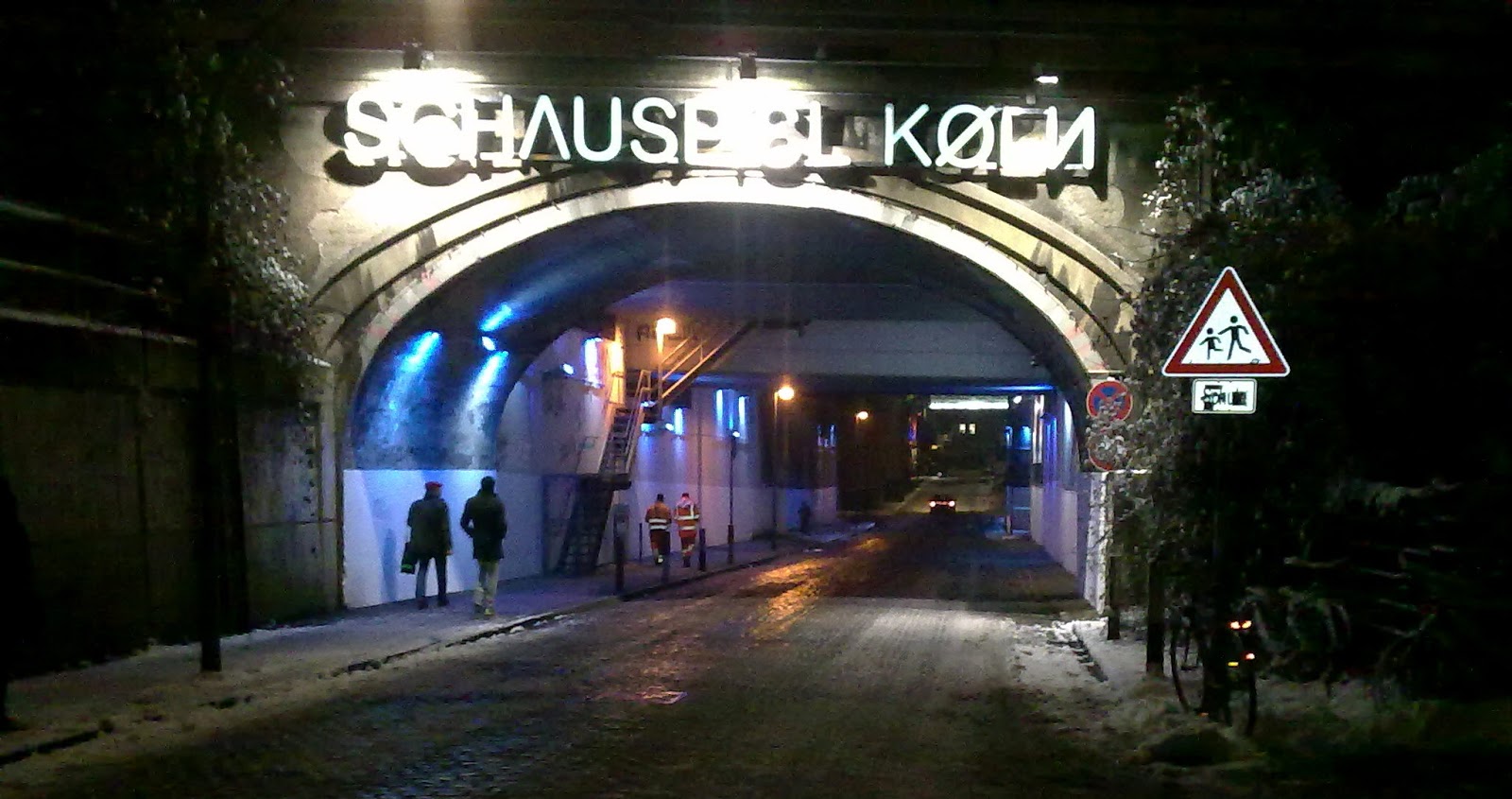
You approach the venue down a side street, the first sign is attached to a railway arch...

under the railway bridge there are massive (overlit, at least for my poor phone-camera) posters for productions...


a view of the building itself.


the entrance...


the front lobby...


the bar, downstairs - like a kind of posh, clean, Shunt Vaults...


and then the lobby upstairs, pretty much fulfilling all my Heimat-based, German theatre-going cultural stereotype hopes in in one vast, white, black-roll-neck-wearers-filled hall...