Sunday, 17 June 2012

The Rest is Silence - LIFT - Riverside Studios

[pretty much a walk-through/blow-by-blow-account as much as a review, so MORE THAN A LITTLE SPOILERY on matters STAGING]


If your idea of hell is spending 90 minutes trapped in an Ikea showroom, then you might want to think about giving DreamThinkSpeak's new show a wide berth.

Premièring at the Brighton Festival, The Rest is Silence is one of those pieces that functions primarily as a magnet for adjectives. It is variously: “thrillingly visual”, a “deconstruction”, “vigorous”, a “new interpretation”, “promenade” and “a multimedia experience”.

Put more simply, it's bits of Hamlet performed from within nine human-sized fishtanks (no water) and some video projection.

You/we the audience stand in the middle of a darkened square room. The perimeter is made of perspex screens. You/we correctly guess that behind these blinded windows will be a series of rooms around the court of Elsinore. You/we are correct*.

The thing opens with a film of [do I need to SPOILER-ALERT plot points in Hamlet? No.] Claudius staggering out of *the orchard* taking a swig of some booze to steady his nerves as he goes, murder committed. The film isn't especially well-shot, nor is the realisation of its projection especially well-executed, but this is all pretty forgiveable. It's by no means a bad way to start, although a bit more style (I was thinking perhaps a nod to David Lynch, Lars von Trier, or to recently discovered Scandi-crime dramas) would have paid richer dividends.

This turns out to be a dream (we assume), since the next “shot”, or “frame” (or “fishtank”) – this time live – is Claudius sitting blot upright in his, y'know, enseamed bed. He pops into his en-suite bathroom next door and starts to practice the speech with which he usually opens Act1,sc.ii. Again, it's quite a neat idea.

At this point, it might be an idea to designate these walls of the room North, South, East, and West, if only a) for ease of identification, b) to give you an idea of how the piece functions, and c) for me to see if, post-fact, there's a bit more logical thought going on here than I managed to discern in the hurly burly of the moment. Let's designate the wall in which Claudius and Gertrude's bedroom, their en-suite bathroom and Gertrude's dressing room are found West.

Cut from West to East, where the Polonius family (L-R Ophelia, Polonius, Laertes) are getting ready in separate rooms.  Laertes is wearing a particularly nasty purple shirt.

Next scene, lights up in North wall, which is one long unbroken room across its three windows. [It was also the wall where the pre-show/video-show was screened] And we're into (a very truncated version of) I.ii “proper”. Claudius gives his “speech” to a video camera that is worked by Polonius. He's sitting on a long low white-leather sofa with Gertrude on his right and Hamlet on his left. Hamlet is sighing and sobbing uncontrollably. Polonius zooms in slightly and eliminates Hamlet from the picture.

[absolutely eviscerated version of] Speech delivered, Claudius gets on with [an also hugely truncated version of] the Any Other Business of the scene; letting Laertes return to his studies in France and giving Hamlet a hard time for still crying about his dead dad. These duties despatched, they exeunt severally; the King and Queen off into the West Wing and the Poloniuses off into the East. Up to this point, I don't think Hamlet has spoken. Claudius has said stuff to him, Gertrude has said stuff to him, but he hasn't given any of his customary replies.

[I hadn't started taking notes by this point, so I might get this next sequence a tiny bit wrong but...]

Hamlet remains sitting in the North room, “O that this too, too solid flesh” comes from somewhere. Does Hamlet say it? I think perhaps he does. Hamlet is played by the normally compelling Ed Hogg who, although I didn't recognise him during the show, played Christ in Rupert Goold's astonishing production of The Trial of Judas Iscariot. He is very handsome – something like a cross between Jack White and Johnny Depp in Dark Shadows - but his chosen *quiet voice* here isn't unlike Alan Bennett reading the Pooh stories (no, I don't just mean he's got a Yorkshire accent, it's something more about the tone). It's initially quite disconcerting; and not in an entirely good way.

While Hamlet keeps brooding, lights come up on the East wing, where the Poloniuses are preparing for Laertes's departure. Daddy Polonius bores his kids with his famous list of advice (Don't be a Borrower, etc.). Then, surprisingly, we skip to Rosencrantz and Guildenstern arriving in II.ii. They get welcomed by Claude and Gert. and are set the task of discovering the source of Hamlet's transformation. This is perhaps the real major deviation from the order of the narrative, at least as published in Shakespeare's name in First Folio.

Those of you who read this blog regularly will know that I'm all for directors slicing and dicing text as they see fit. Indeed, I'm still toying with running this review in tandem with my now long overdue report on the Globe To Globe Lithuanian Hamlet, so I surprised myself by coming over all Michael Billington here. (It is, of course, only natural that Michael, therefore – in what I can only describe as a spirit of pre-emptive perversity – decides to go a whole bundle on this).

I should be clear: To be honest, I'd been *expecting* much less text. I was surprised that something so at pains to distantiate itself from “Hamlet” – the changed title, the wafty publicity image, all the talk of “deconstruction” – was actually, snazzy set aside, turning out to be little more than a Very Cut, modern dress production. Therefore, I was puzzled by why director Tristan Sharps had brought Rosencrantz and Guildernstern's entrance forward. Of course, there's no real reason not to. Claude and Gert don't *know* that Hamlet has previously met with the ghost of his popped-off papa, who fingers Claude for his murder. But, the audience knowing this does invest subsequent scenes with a lot more tension.

That said, I suppose we the audience have been unambiguously *told* – via video – that Claudius has done *something bad* before the live acting even starts. (I still think there's a strong case to be made for a Scooby Doo version of Hamlet in which “the Ghost of Hamlet's father” turns out to be Fortinbras in a scary costume).

Already I started to get interested in who the ideal audience member for this show is. What I mean is, to what extent is Sharps trading/banking on his audiences knowing Hamlet Very Well Indeed, and to what extent is he hoping that we will leave all our foreknowledge at the door and just attend to what he is actually showing us?

The next bit, [at least according to the notes I'd by this stage started hurriedly trying to tap into my phone as discreetly as possible] sees R&G “repeating” things Hamlet has said to them back to each other. It's more than a little Stoppardian. It is also, initially, excruciatingly irritating.

[I should concede that I was possibly not at this point the ideal audience member. I'd been up since seven. Had done a whole day of stuff already elsewhere, and was possibly not best pleased by having to stand up for the next 90 minutes. Maybe not the *ideal* audience member, but possibly not a-typical of yer average Londoner. I mean, the show starts at 8pm. Most people will have been at work all day. While I'll concede that LIFT *is* a Festival, Londoners aren't, for the most part, really able to avail themselves of the atmosphere festive all day long... Anyway. In short: I'm old, I'm crabby, I prefer sitting. Grumble over.]

My initial irritation with R&G stemmed largely from the fact that they seemed to be being played as a pair of brainless, camp idiots; and there's only so much facetiousness one can stick into a characterisation before you genuinely want to punch *the character* in the face.

I was also getting increasingly put off by the shiny, nouveau, *new*ness of everything. I wasn't kidding about it feeling like an Ikea showroom. And part of that was the fact that none of the rooms felt like *real* rooms. I totally get how that could be a directorial decision, but that doesn't mean I had to agree with it or think it worked.

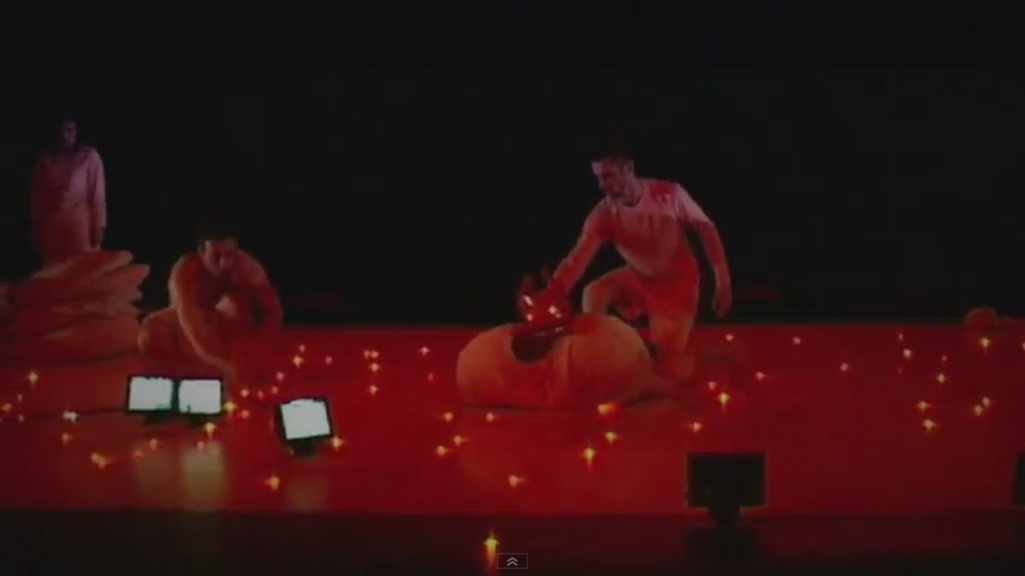
Interestingly, looking at the production/publicity photos of the show emanating from Brighton [see top], the rooms look like they were a fair bit bigger there. And I wonder if DTS have had their vision slightly compromised by the lack of available size at the Riverside Studios. Because I did increasingly feel that the crampedness of these rooms was a significant contributing factor to my initial problems with the piece; like the performers were too pressed-up-against their glass screens (presumably mirrored, or at least highly reflective, on their side?); so that they didn't really have nearly enough space to, well, to *act*. Certainly not to be able to act with the requisite level of realism/natural-ness demanded by the set up. They all looked way too caged. Which, sure, could again be part of Sharps's regie-conception, but the tininess of the rooms conflicted with the expense of the furniture. (Yeah, while it's Ikea-showroom-like in conception, the furniture is definitely a bunch more upmarket).

But anyway, R&G (they're in the South wall, right hand room) report more of Hamlet's lines while Hamlet himself sits and broods, more spoken-for than speaking. Quoted but not understood.


It strikes you (well, me) that the removal of Horatio is especially cruel, and really changes the dynamic of the play. I'd never much figured Horatio as terrribly important – although I've recently been fascinated by the Eastern European insistance that he's almost certainly a double agent working for Fortinbras all along. But, my God, does Hamlet look isolated without him. Indeed, I would argue that this is the most unkindest cut of all, certainly the cut that most changes the dynamic of the story. Instead of always having someone to hang out with, talk to, explain his thoughts, feelings and plans to, Hamlet looks completely miserable and borderline psychotic. It's remarkable the extent to which him explaining what he's up to makes him more compassionate.


Of course, there are other substantial cuts. the players are dispensed with altogether, but then so are Hamlet's doubts as to whether or not the Ghost – who finally shows up now – is telling the truth.  In this version, the ghost's speech is pared down to bare facts. He's been killed by Claudius and he was “sent to [his] account / With all [his] imperfections on [his] head”.  This speech was delivered in near total darkness. Which was highly effective. The ghost's moan: “O, horrible! O, horrible! most horrible!” was indeed chilling, if you bought into imagining what it meant for Old Hamlet's immortal soul.

The Ghost gives Hamlet a gun. I shall not speculate as to how something as airy and insubstantial as a ghost manages to carry a gun. It is probably a metaphor. Anyway: net result, Hamlet is now armed with the knowledge of his father's murderer's identity and a gun.

There follows a long sequence of Hamlet pointing the gun. First at the mirror in his room (South wall, centre panel), then at himself, then back at his bedroom mirror – behind which, of course, we are standing. And, thanks to the freedom of movement afforded by the staging, you can play “chicken” by standing in front of Ed Hogg looking like he's about ready to shoot you in the face. I didn't last very long. It's harder than you'd think, even when you know that the gun is fake and Hamlet is only an actor.

Hamlet chucks stuff around his room. The wide-screen video thing comes back up opposite on the back wall of the North room, as if the room now gives out onto a view of the Orchard, however , it turns out to be the flashback-to-the-murder thing again – this time – while Claudius and Gertrude dance together in the room – showing Claudius entering the garden and dropping the poison in Old Hamlet's ear. Then the Ghost of Old Hamlet enters the room and Claudius, overcome by his guilty memories; and Gertrude, by this ghost she can't see; run off a-whimpering.

Hamlet does some more gun-pointing at his wall.

Lights up on the East wing and there's a cute bit with Ophelia making “wheeeee” noises on her father's smart office swivel chair. This is perhaps the moment that crystallises one of the things this production *is* giving us – a lot of the “off-stage” “unseen” moments. It's not an especially *new* idea – I'm pretty sure I've seen other productions explore/offer similar things – but thanks to the overtly explicit privacy these characters enjoy (they aren't even having to *pretend* the fourth wall). We get to see the characters doing “those little personal things that people do when they think they're alone” (cf. Jonathan Miller in Beyond the Fringe). It is tempting to think that *those things* aren't, necessarily, perhaps, *these things* that we're being shown, however.

I think we then see Hamlet go to Oph.'s room, kiss her and then push her around a bit. I'm not sure, given what we've actually seen of Hamlet's emotional journey thus far, or of his relationship with Ophelia, that we've been given enough to see this as anything other than nastily abusive. But perhaps the production either a) doesn't mind – suggesting that Hamlet has been made genuinely mad (without Horatio, there is no talk of antic dispositions), or b) is expecting us to bring a bit of context with us into the theatre.

The next scene is the most inventive yet. In three separate identical version of Hamlet's bedroom on the South wall Claudius, Gertrude and R&G separately rifle through H's possessions (the inevitable Scandi-crime novels – Jo Nesbo features prominently – Dostoevsky and H's diary...). Scattered drafts of “To be or not to be...” litter the floor, like so many attempted suicide notes. A clever touch is that each version of the room, while running simultaneous, picks up where the last left off, and we can discern a difference of approach between Gertrude's gentle, genuine concern, Claudius's paranoia and rage, and R&G's inevitable total mystification.

And, as night follows day, “To be or not to be...” arrives, spoken, not by Hamlet, but severally by Gertude, Claudius, R&G and Polonius. I watched Richard Clews version as Polonius, reading direct from the diary, or as copied into his notebook, reading it exactly as a father of a daughter whose recent ex-boyfriend was given to writing overwrought fantasies of misery. It's "To be or not to be..." done with utter scorn, and actually a very fine, detailed performance. He stops and repeats the sillier words (“...who would fardels bear? Fardels?”) wearing an expression of complete contempt. I liked this a lot.

Cut to:  East Wall

Ophelia rehearsing her “I have remembrances of yours / That I have longed long to re-deliver” in her little cupboard.

[I made the brief note: - Man, this is the stuff we *really* *don't* *want* to see – and there is a certain element of that to this production. The idea that Shakespeare mightnot have written in some scenes because they wouldn't have been very interesting. This is Hamlet stripped of all its majesty and rendered down, and reduced, at times, to somewhat trite moments of teen-romance melodrama. After all, Ophelia's misery is no more tragic than anyone elses who's just been dumped. Sure, it feels bad to her, but incredibly she comes out of the original with more dignity than she does here]

We then move back in time in III.i to the bit where Polonius, now we're on the North Wall large room, where Polonius co-opts Oph. into his desire to spy on Hamlet. Ophelia assents  and starts to deliver her “I have remembrances...” speech at Hamlet as soon as he enters...

But then Gertrude crashes the scene and Hamlet begins cross cutting his later attack on her in her chamber into his break-up row with Ophelia.

So there he is, having a row with his mother and his girlfriend *at the same time*. Did ever readings get more Freudian, or more messed-up? No wonder it hath made him mad.  He's mixing up his lines and his women. *Both* ladies in his life are ordered to nunneries. Gertrude gets lines aimed at Ophelia; Ophelia, Gertrude lines. It's rather wonderfully effective, and Ed Hogg kicks into gear and really lets rip here. It's barnstorming, angry stuff. The only surprise is that, with all his pent-up rage, he doesn't actually smack someone in the face.

Little wonder that he winds up shooting Polonius. Mercifully, Ophelia has already fled the room before this happens. But it's still speeded up the play no end. Skipping effectively straight from III.i to IV.i

[thanks to my incomplete notes, I've now got no idea where they slotted in the bit where Hamlet *doesn't* shoot Claudius in the head while he's praying – after C&G have had their dance, perhaps? But anyway, that scene isn't missing, it's just been moved somewhere]

From here, we find Laertes turning up in the Claude&Gert West Wall bedchamber and waving a pistol in the Royal face and demanding to know what happened to his father. Then Ophelia totally loses her shit in the East Wing.

That said, by this point, you are (I was) really starting to wonder if this is still meant to be set in a “Royal” household at all. This was another instance of that unhelpful bring-knowledge-in/leave-it-at-the-door conundrum. Certainly for the first couple of acts I was still figuring the play as set in a Danish royal family. And, thanks to the way that modern-dress productions have taught us not to watch Shakespeare too literally for clues, I was doing fine with that. Claudius wasn't exactly “regal”, nor Laertes *noble*, but then I've seen enough Northern Broadsides shows to be more than aware of social class hopping productions. On the other hand, the production was doing nothing to suggest, encourage, or even confirm the idea that the dramatis personae were still Royal, save perhaps for the video-taping of the *very* cut version of Claudius's speech (therefore, I couldn't swear he doesn't mention anything about Kings, Queens, or Kingdoms, but I don't remember him doing so [answers in a comment if you happen to *know*]). On the other hand, if he *isn't* a King, what on earth is he doing making a film where he talks about his marriage to his recently departed brother's widow?  That's Life?

And, as me and a couple of friends joked after the show, if they aren't a royal family, what the hell is Polonius now? Some kind of spooky cousin? Brr. Anyway...

Next up we whizz back to the South Wall which has now been transformed (well, left and right) into the boat on which Hamlet, under the care of Rosencrantz and Guildenstern, is sailing to England. As you know, we never see this in the play. What Sharps has cleverly done here is take the instructions that Claudius gives them beforehand, and then the account that Hamlet gives of the journey afterwards and mixes them into it happening in real time (we are shown, not told, in fact. And as well as being one of the freshest inventions in the show, is also one of the things that works best – it makes me think that Sharps should have taken more time and shown us much, much less of what we do normally see in Hamlet and made up more stuff like this that is implied – although that way possibly lies Rosencrantz and Guildenstern Are Dead II - Still Dead (?), and fewer marks for originality. Saying this does make me idly wonder why this *isn't* a “multi-media”, “promenade” production of that play – presumably because it's more expensive and not a classic. Anyway, more matter, less waffle, Haydon...).

Admittedly, I'm a child, but I did really like seeing Hamlet's hand snake into R or G's jacket pocket, hung up on the back wall of an on-deck gazebo and nick the letter condemning him to death, and then pop up in his own cabin a minute later, write his own version, seal it, and then whizz back to R&G's little tent and pop it back into the pocket.

All the while, R&G are still playing with the torn up fragments of the To Be Or Not To Be... speech that they found in Hamlet's bedroom, and trying to piece together the thought-process it could be using the same words. This results in a pair of lovely, new speeches made from the words of the original. And they're nicely done: slightly surreal, and ultimately poignant, not least because we are now acutely aware that both are now facing imminent death.

Amidst all this nautical fun, we also get the burial of Ophelia via video-projection on the ceiling. It's basically a corpse-eye-view from within a glass-topped coffin – i.e. we see Gert, Claude and Laertes looking down and a close up view of some soil landing on top of us until there's no more light.

And all this while Hamlet's still all at sea.

I know! Right?

Whither the gravediggers? What about poor Yorick?

Still, it does speed the action up no end. With Ophelia buried beforehand, when Hamlet gets back we can get straight to the fight at the end, with none of the usual pissing about and prevaricating.

There are only four characters left.

With no Horatio and no Fortinbras, and in a production with no extras, this last scene is a curious thing indeed. It starts with four characters and ends with four corpses (needlessly, since I don't recall Claudius setting by the usual “chalice for the nonce” which ends Gertude's life, but nevertheless, there it is, there she dies, and despite no one seeming to explain anything out loud, Hamlet seems to manage to force Claudius to drink it, as well as stabbing him with the poisoned foil).

When they are all lying dead, the video-projected face of a giant Old Hamlet looks in through the big windows and weeps.


[needs a bit of a round-off/analysis but I'm knackered and this is too long already]


*Well, correct, except in might not be Elsinore

Thursday, 14 June 2012

Gatz – LIFT – Noël Coward Theatre

So you know the basic deal here, right? Gatz is an adaptation for stage of F Scott Fitzgerald's novel The Great Gatsby. Or rather, it's EVERY SINGLE WORD OF THE GREAT GATSBY BEING SPOKEN IN A THEATRE. It's EIGHT HOURS LONG (including x2 15 minute intervals and 1hr30 for dinner).


And: IT IS ASTONISHING.

But, what's really exciting about this production of a very well-known book is that, even if you've read it, the review will still need spoiler warnings; not because they've changed the book one iota, but because it is a staging that just keeps on surprising you.

So, what to do with this review? Well, my bet is the poor ladies and gents of the MSM will cover the not-too-spoilery review front (and it was genuinely heart wrenching seeing them all having to sprint from their aisle seats during the spontaneous standing ovation as soon as the show finished so they could go and try to sum this enormity up in 500 words before tomorrow morning), so this one might be better aimed at trying to decribe the event for people who won't get round to seeing it.

So, before I start, if you can get hold of a ticket, stop reading and do that instead. Gatz is extraordinary. An absolute must-see. All that stuff.


So, why's it so good?

Well, let's start slowly. The first great thing about it is what LIFT and Elevator Repair Service have done with the Noël Coward. Basically, the stalls seating has been replaced by a rake which runs from the front of the stage to the beginning of the first (Royal, I think it's called) Circle. This totally transforms the way the space feels, turning it from fusty, old-fashioned Pros. Arch to a match-fit space almost bursting with an energy all of its own. I mean, it must have lost the theatre quite a few seats, but if I was in charge, I'd be incredibly tempted to keep it. It makes the space feel infinitely more democratic. It totally changes the audience's relationship with the stage, and with other sections of the audience.

So, that's one thing, and it's totally unrelated.

But what of the production? It's someone – his name is Scott Shepherd – “reading” most of The Great Gatsby to a theatre full of people. “Reading” gets quote-marks because apparently he isn't reading at all. He's memorised 48,891 words, and just carries the book around turning the pages, for, well, for a lot of really good directorial/dramaturgical reasons. Not least of which is the frisson he gets about half an hour or so before the end when he closes it and does a whole section straight-to-audience.

So what does that look like? Well, here's the next brilliant thing, in a lot of ways it's totally non-naturalistic. Well, no. Let's unpack that. It uses naturalism a lot, but as a series of textures. I'll try to explain. It opens with Scott Shepherd – the actor, although Lord knows who he is at this point – walking into a very detailed naturalistic set of an office. Possibly a basement since the only windows on stage give onto a cheap-wood panelled corridor. And it's an office basement from, well, roughly speaking, the late eighties or early nineties – there's one computer and one electric typewriter (although the computer does seem to have an, ahem, “wireless” keyboard. Tsk), there's a large mobile phone with one of those aerials. It's not quite a brick, but not far off. And there are boxes and boxes of files on paper, stacked in those large metal shelving units generally found only in basements and garages.

This set never alters. Well, elements within it are moved around, but the basic dirty grey walls never shift or open magically to reveal 1920s interiors or anything. This is your lot, set-wise. But, actually, it's more than enough. And it's incredible.

Scott walks in, tries to switch on his computer and, while waiting the customary hours for a 80s/90s PC to boot, pings open his card index Rolodex(- is that right?) and discovers just a copy of The Great Gatsby inside. He looks at it, puzzled. And then opens it and starts to read. Out loud. And for a while, this is all we get. And that's fine. Gradually “his” co-workers begin to trickle into the office. Who *he* (Scott) is, is not pinned down. Partly he's the actor Scott Shepherd; partly this unnamed, anonymous office-worker; and now, partly Nick Carraway, the narrator of and character in The Great Gatsby.

A little while in, while he's reading to us – doing all the voices in the dialogue – one of his co-workers come over and mimes the gestures and the mouth-movements as he speaks another characters part. There's a beat. He looks at her. There's still this game of tension being played between “this is a man in an office reading a book” the “knowing we're all in a theatre” and “going *inside* the story”. Something that I absolutely love about the show is the way that it never seems to seek to fully resolve these three levels. At any given moment we can switch rapidly from a nod to the audience, to some guy in an office reading a book, to really involved dialogue in the novel.

The “casting” also makes use of this device. The performers all come in dressed for a day in the office. They are primarily playing office workers. As they are gradually co-opted by the demands of the novel, they might occasionally slip into something more period-appropriate, but there's a sense that they never “become” their characters. [Ok, I'll go there: this is the closest thing you can imagine to “Brechtian naturalism”]. Also, it feels like there are very few members of the cast whose physical appearance doesn't directly contradict that of the character they're playing/representing/*doing* from the novel. Mostly they're older, different shapes, have different colour hair – there's a lovely sight gag when at one point Nick tells us that women used to rub champagne on Gatsby's hair. He looks up at Gatsby (Jim Fletcher), who is mostly bald, and shrugs.

And this is the real power of the thing. We're given everything in profusion, but ways that make all the elements strain against one another to keep on reminding us that this isn't *just* a play, or *just* a reading of a novel, or *just* an incredible feat of memory, or *just* some excellent performances. ..

Actually, the extent to which these amazing performances still manage to foreground the writing time and time again is quite remarkable. I think I read TGG once, but I'm a pretty bad reader and it didn't make much of an impression. Here, where individual sentences are taken out and given as much space as they need to breathe, the effect is frequently almost dizzying. It felt like a revelation that there is *so much* *really great* prose in the book. There is also the odd duff line. At one point, Nick describes Gatz thus: “He was a son of God--a phrase which, if it means anything, means just that” - they're sitting opposite each other across the table in early morning light, and the context is one of extreme melancholy. Gatz lifts his head and Nick just looks at him, points to the book and makes a gesture which eloquently says: “Don't look at me like that, I didn't write it”.

Something else that foregrounds the writing, or makes the text come alive, and something which I think is actually at the core of the success of the whole production is Scott Shepherd's voice. Well, it's his whole presence; from the scrubby, wiry-looking, gingerish hair; interestingly lined, careworn-but-hard face; and resolute versus hangdog posture. But it's the voice most of all. It was in the opening moments of the final quarter when it struck me: Shepherd reads the book like Johnny Cash sings. I don't mean this sounds like “Johnny Cash reads Great Gatsby”, it goes further than that. The grain of Shepherd's voice brings out a similar musicality from the rhythms of Fitzgerald's writing. And it's this music the underscores the whole. Because, while Fitzgerald's novel is superficially born of the inter-war Jazz Age and the East Coast, really it's about a bigger America than that. That's another element that this production brings out so well. Space and weight are given to the sections where Nick reflects: “I see now that this has been a story of the West, after all--Tom and Gatsby, Daisy and Jordan and I, were all Westerners, and perhaps we possessed some deficiency in common which made us subtly unadaptable to Eastern life”.

It's interesting (and significant) that Elevator Repair Service have called their reading of the novel “Gatz”. Gatz is the original birth-name of the titular Gatsby. And in the programme the characters are identified by their Christian names only, almost as if to give them a chance. The Gatz of the novel reinvents himself over the six years following the end of the First World War until 1922: he “has a good war” and is promoted; goes to Oxford briefly as an ex-American serviceman; and returns to America to work for, well, perhaps the novel's most problematic character; a Jewish gangster called Meyer Wolfshiem.

[Perhaps reflecting our contemporary discomfort with Fitzgerald's characterisation (when he is introduced Nick speaks of him mostly as a nose), which borders on, if not crosses right over into, anti-Semitism, Wolfshiem appears to be the only significant figure in the book who is never really represented by an actor; even Gatz's father, a tiny walk-on part, gets a whole actor to himself, but Wolfshiem is sat-in-for in one scene, and just narrated by Scott/Nick in the other.]

The point of this reinvention is essentially his desire to realise himself according to his own massive estimation of himself. Later it might be driven by his desire to win the heart of the first nice girl he ever met; Daisy, but when his father shows up, he reveals to Nick the then Jim Gatz's copy of Hoppalong Cassidy in which the under-ten (?) Gatz Jr. has written a schedule for ambitious and dedicated self-improvement.

I guess it's all too easy to suggest that along with the rolling descriptions of America's landscapes, and the evocation of “a fresh, green breast of the new world”, Gatz/Gatsby also stands in for something like a dreamed-of embryo of the American Idea, but it also feels too potent a truth to ignore. That said, it is interesting that Fitzgerald in 1925 already divides his nation along East-West lines, since at that point the North-South divide of the American Civil War was more recent to them than WWII is to us now.

There's a suggestive note in the programme observing that TGG was published only four years before the Great Depression took hold. And there is curiously, counter-intuitively, something pre-lapsarian about the dingy basement in the late-eighties setting; a place where wings have yet to take dream, if you like. It is possibly somewhere between cheap and downright wrong to read anything and everything that comes out of New York now though a lens of post-9/11-isms, but here seeing the shadow of those now-absent towers doesn't feel entirely misplaced. On the wall of the office set the only picture is of a skyscraper. I'd have guessed The Empire State Building, but perhaps it is something earlier, something extant in the year that TGG was published (apparently the Woolworth Building was the world's tallest building in 1925). The skyscraper being perhaps another Gatsby-like bit of proto-typical American self-fashioning. Because this really is a state-of-the-nation staging. This is every bit as much about America as it is about our common humanity.

But, as Nick says:“Life is much more successfully looked at from a single window, after all.” And this is how and why both the novel and this staging of it operate and succeed. From a set of specific circumstances, performed within a pretend different set of circumstances, Gatz feels like it opens up not only a novel but the world.

In short, Gatz is a very, very fine piece of theatre indeed.

Also, did anyone else think to do the available “Elevator Repair Service fix LIFT” gag?

Sunday, 10 June 2012

Wege aus der Krise

Timon aus Athen – Bremer Shakespeare Company, the Globe
Caligula – Benedict Andrews, ENO


Are there instructive comparisons to be made between a new German attempt on an early-modern English attempt on an ancient Greek life and an Australian's contemporary attempt on a pre-WWII French version of a classic Roman for the English National Opera?

As wags have already suggested, it was wry of the Globe to kick off the Jubilee Weekend with another Greco-German alliance. But once safely cloistered within the Globe's oddly comforting plaster, beams and thatch – away from the thousand union flags to which London been subjected – actually watching the play, the choice of having this story of a likeable spendthrift Greek being performed by Germans seemed to contain a much more meta-commentary on the the current state of the eurozone than anything to do with Britain's antique monarchy.

However, in the Bremer Shakespeare Co.'s production, “meta-” is where this commentary mostly remains. What we're given here – at least as far as I could observe – is a pretty straight-forward run through of the action of the play, cut to two hours, and performed without too much dwelling on the more “tragic” aspects of this “problem play”.

I say “straight-forward”, although I imagine a lot of Shakespeare “purists” will claim that the production was almost entirely bonkers. Indeed, I heard one old codger at the interval muttering that there was “almost no justification for that trampoline at all”.

And, well, no; textually, there's very little in any of the published texts of Timon of Athens to suggest that Shakespeare definitely intended that the table around which Timon invites his guests to sit in Act III, Sc.vi should be a trampoline. On the the other hand, there's no point where he definitely says it shouldn't be either. Indeed there's very little in Shakespeare's texts concerning scenography and costuming at all. Apart from the occasional plea (most notably in Henry V) for audiences to overlook the fact that what's on stage looks nothing whatsoever like the real thing.

But, yes, since this is a German production, it contains the apparently de rigueur full-frontal male nudity, animal masks and stage mess. Now, the cynical and jaded could suggest that this is evidence of a somewhat calcified system of stage semiotics (I'd contend it's actually a lot more to do with coincidence, having seen plenty of German theatre which contains none of the above), on the other hand (or even *at the same time*), maybe we should view this recurrence of such strategies as confirming a certain level of centrality that thy have achieved, and start to think about them a bit more seriously than just noting that they are “enjoyably bonkers” and wonder not only what but *how* they mean.

Actually, it's worth pointing out that the animal masks here aren't really doing anything more than *meaning* “some animals” who prance on and wiggle about a bit during Timon's speech in which he bitterly compares their worst characteristics to those of humans.

In fact, this production's overall gentle, un-pointed, “Regietheater-lite” approach suggested quite a useful bridge between British and German directing cultures, opening the option of a sliding scale of *types* of “director's theatre”. Because, for all the invention and mucking around on show in this Timon, it also reminded me a lot more of, say, Kneehigh's Cymbeline, than of the High Seriousness that we might sometimes think we should expect from the Germans. In short, it reminds us that as well as having a lot of theories, Brecht also wrote a lot of clown shows.

Timon aus Athen, BSC


By contrast, Benedict Andrews's production of Detlev Glanert’s Caligula at the ENO is perhaps the more familiar type of director's theatre, or rather opera.

The curtain (yes, Mark! There's a curtain, thank God!) rises, audaciously, on set designer Ralph Myers's meticulous recreation of a massive bank of stadium seats.

It is at once both impressive and flat; strangely attractive in its implacable gaze, yet ugly and functional. It reminds us of ourselves as an audience. It co-opts the same sense of the uncanny as Tim Crouch's The Author. At the same time, this type of plastic-seat, single rake is about as far away as you can get from the frou-frou chocolate boxiness and strict price differentials of the ENO's Colosseum (although, it was strangely appropriate to see something *about Rome* there, what with the auditorium's frankly bonkers addiction to ornate Rome-themed ceiling decorations. Seriously; don't look up unless you've got a strong stomach for Classical Imperial kitsch).

Down the central aisle of this stadium seating, under pretend-moonlight lighting, wafts a naked woman, covered vaguely in a wispy veil. Who then keels over, dead.

This, we quickly learn is Drusilla, sister of Roman Emperor Caligula. Or at least Caligula as imagined by “French” “existentialist” Albert Camus (he was born in Algeria to a Spanish mother and flatly denied being an existentialist). Caligula turns up, disguised, wrapped in a blanket and demands his servant Helicon brings him the moon. Various high-ranking Roman dignitaries arrive and discuss the fact that Caligula has been missing for three days. Caligula eventually reveals himself to them. Alice Babidge has dressed the cast in unfussy modern dress. Grey suits are pretty much the order of the day.

Perhaps the best moment of this first act is when from both sides of the stadium seating rake a vast number (for theatre) of chorus members file into the seats. Dressed in studiedly everyday clothing (strikingly most reminiscent of those socially-housed East Londoners who periodically turn up on the news to patiently explain how they've been turfed out by the coming Olympics), we get the sense of a population of a city.

And, as Matt Trueman has already intelligently suggested, one of the cleverest things about the design is the way that it implies so many more identical blocks, so many, many more people. Because, while on one level this is a personal narrative of a one man's madness, thanks to his position as third Emperor of the Roman Empire (although not, crucially, a dictator), the real story here is that of the actions and effects of tyranny.

What is interesting about Andrews's production, given its nominally “contemporary” setting, the rogue appearance early on of the now clanging slogan “We're all in this together” and the fact of a stage dressed as a stadium, is the slightly spurious feeling that this is a Credit-Crunch, Jubilympics, Caligula 2012 kind of affair. One of Caligula's first acts upon his resumption of power is to respond to the Roman Empire's bankruptcy by declaring obscene tax hikes on pain of death, ostensibly to pay for more of his own lavish, stadium-based grandstanding. To which the best response is: “You might very well think that, I couldn't possibly comment”.

Of course, the iconography of the stadium within a dictatorship goes a lot further than our own misplaced, narcissistic grumbling about the Olympics: from the murderous games at the original Colosseum, oddly recalled in the decoration of this opera house; through Berlin in 1936; to Pinochet's use of the Chilean Estadio Nacional as a concentration camp in 1973 (Sebastian Errazuriz's Memorial of a Concentration Camp is noted in the programme) – part of the impetus behind Sarah Kane's Cleansed -- and more recent atrocities like the Guinea Stadium Massacre and the even more recent massacre in the Port Said stadium, Egypt.

All this is conjured and echoed through those staring blank rows of identical yellow seats. Through this set we are given a sense of the enormity of the horrors which is strangely absent from music, libretto (Hans-Ulrich Treichel, trans. Amanda Holden) and to a great extent even the action itself.

Caligula, Yvonne Howard, Peter Coleman-Wright, Christopher Ainslie (c) Johan Persson


The other major iconography deployed in the mise-en-scène is that which might be described as German Theatre Kitsch. (Yes. There's coherent reason I'm reviewing this with Timon). In the second half, Caligula has erected a spangly kind of “stage” (silver foil curtains et al.) in amongst the seats of the stadium, and performs a burlesque as Venus, replete with long blonde wig. And elsewhere, Yes! there is the full-frontal male nudity, moderate stage-mess and, eventually, some members of the crowd crop up wearing animal heads (as long as papier-mâché Kermits and Miss Piggies, Mickey Mouses, Donald Ducks and Mutant Ninja Turtles count as animals). Yes; Benedict Andrews has worked pretty extensively in Germany – a look at the photos on his website suggest him as an something of an Australian Ostermeier, although the aesthetic here is far closer to that of the kitsch rage of Castorff and Pollesch at the Volksbühne than the often refined, elegant, sometimes-chilly minimalism of the Schaubühne.

(an aside: Ostermeier's aesthetic was once criticised to me by another German director for making stages reminiscent of Der Preis ist Heiss – Germany's post-unification version of The Price is Right, apparently launched to teach capitalism quickly to the Osties – on the grounds that you basically sat there wondering how much the sofas cost rather than watching the play).

So, that's what it looks like. Which, in the event, was what preoccupied me a lot more than what was happening or what it sounded like.

Detlev Glanert's opera dates from 2006. I don't know how much modern opera you've heard. I've heard *some*. What struck me as interesting was how *old* this piece sounds for something written only six years ago. I don't mean old like Monteverdi or Mozart, but it's not so very far removed from, say, Schoenberg's Moses und Aron or Berg's Lulu (at least to my inexpert ear). This isn't to detract from a musical achievement, which has been hailed elsewhere as the greatest opera of the 21st century (a judgement I'm in absolutely no position to dispute), but it is surprising, given other developments since then, that Glanert has written something which almost harks back musically to the era when Camus's text was written.

Conductor Ryan Wigglesworth's take on the orchestration seemed fine to me, although I was struck by the fact that, from where I was sitting at least, it all sounded quite quiet. I was more struck by what I thought was a certain lack of specificity that Andrews had allowed to pass with his performers. Perhaps unfairly, my main point of comparison here is Katie Mitchell's astonishingly detailed, naturalistic Idomeneo at the ENO a couple of years ago. From what I remember of other operas I've seen – longer ago, and probably at The Other Place – this Caligula is still comparatively-at-large incredibly precise and fluid, but it did still feel like specific moments of real threat and tension didn't quite hit home with the necessary ferocity.

Because, overall, what comes across here is a drama that needs to show us a man in charge of a city, country and empire, depicted as, say, Scarface, or a gangster from Goodfellas, or The Godfather. The threat of violence – given the way this production looked and seemed to operate – felt like it had to be more immediate, grotesque and terrifying.

As such, however, it reveals that just as Timon of Athens isn't really a play about the Greek economy, is Caligula really isn't a piece about austerity and the Olympics. So is there a useful thought to be gained from having proposed either in this way? I would argue that there is.

What I think happens here, is that when certain recognisable elements of modernity are hinted at or invoked, even if only glancingly, well, I wonder if different centres of our brain are engaged. I wonder if, rather than “just” “story-enjoying”, we also, additionally, start “thinking politically” (heavy, heavy scare marks for that second proposition). What I suppose I'm suggesting is that, from the point where something contemporary strikes us about the situation of the play, then the play itself doesn't then have to then go on to map exactly onto that political issue, but we in the audience might start to *read* the play, if not as an analysis of the contemporary predicament, then with at least with our interest in contemporary events.

This is a pretty un-constructed theory so far, but I wonder if it opens up a possible route out of the slight cul-de-sac that is describing everything as “relevant” as if this were the only possible virtue for modern performance. I suppose I'm proposing that glancing reference can awaken our contemporary political understandings and bring them usefully to bear on how we attend upon classical tales.

Perhaps such thinking, if it makes sense to anyone else, or gains any traction (assuming I'm not just coming up with something someone's already said much better somewhere else), offers a different way in directors might be able to approach extant texts, and, rather than inexactly nailing them onto an entirely different historical context, can allow the texts themselves to function both as themselves and through a series of more open-ended suggestions.

It feels, as if this is how both the Bremen Timon and the Andrews Caligula already functioned – political, without declaring their politics; questioning, without specifying exactly the terms of their inquiry – and yet, somehow avoiding being vague by presenting very definite motifs and routes into their questions: thought-provoking without didacticism.

Caligula, Peter Coleman-Wright, Ensemble (c) Johan Persson

Saturday, 9 June 2012

The Physicists – Donmar Warehouse

[much better, edited version available at Exeunt]


Having recently offered a lengthy defence of reading programmes and pre-publicity material before seeing shows, I found myself walking into The Physicists almost completely without a single clue as to what I was going to be watching.

More alarmingly, by the interval I still couldn't really have told you.

Here's what I did know: I knew it was by Fredrich Dürrenmatt (whose dates, and nationality I'd temporarily mislaid), and I'd known for a while that it was a new version by Jack Thorne, who I know a bit, and who'd sent me a message on FB saying how much he loved the play. Without looking at the programme, I couldn't have been sure who had directed it (I guessed, rightly that it was probably Josie Rourke). But that was pretty much it, in terms of knowing what to expect. Indeed, this review got commissioned about an hour before the show went up, before which point, I hadn't even been going to go to the theatre.

As a result, I found myself watching the play more intently than normal for clues as to what sort of a play I was even watching, what it was about, and how it was meant to work.

The play opens on a tableau of a murder scene. A red-faced Detective Inspector (Jon Ramm) and a couple of scene-of-crime officers staring down at the prostrate body of a young female nurse who has been strangled. They are accompanied by a sinister, plus-sized matronly nurse (Joanna Brookes) and later, met by the director of what is apparently a mental institution, Dr Mathilde von Zahnd (Sophie Thompson).

So far, so straight-forward.

Designer Robert Jones has set the action in front of a tall white wall covered in doors (not at all unlike Piet Hein Eek's recent interior design - though Jones's is cleaner, more stark, more artificial), there's a white, leather, designer armchair and an artfully arranged table with a couple of lamps. In the far right corner of the stage, a large oil portrait leans ominously against the wall. It's a pretty set, and one that tells us absolutely nothing. Well, very little. We're in Classic Play Land, clearly. New Writing never has sets like this. Reading the semiotics of contemporary British scenography, we now know that we're looking at a play for which location-specificity can take a back-seat in order for a more general sense or hint of “a place” or “an idea” to be foregrounded.

Costume-wise, We're definitely in the 20th century. The characters seem to be wearing outfits dating from after WWII, but of a rather “timeless” variety, which could intend anything from the mid-fifties to almost the present day.

If the visual aspects of the production refuse to give too much away, it is the acting which cements the faint sense of opacity. Put simply, firstly the performers do seem slightly to be in different plays. John Ramm's detective inspector has more than a hint of the Trustcotts about him – an almost archetypal red-faced, hat-clenching frustrated police fury. A comic Lestrade, if you like. Similarly, Brookes's mental health nurse offers more than a hint of the Hattie Jacques. Added to this side of the equation is Sophie Thompson's turn as Dr von Zahnd, coming on most like something Peter Sellars might have done if he'd ever been playing an elderly, mad, hunchbacked, female German (or Swiss, I suppose) director of a mental institution / crazed-industrialist.

On the other side, against this are the portrayals of the three titular physicists. The initial shtick of play is that behind three doors in this asylum are three mad men who variously believe themselves to be Einstein (Paul Bhattachargee), Newton (Justin Salinger) and Möbius (John Heffernan). In this instance it is Einstein who has murdered the prone nurse (Miranda Raison off of Spooks – who does do more than being a corpse later), but we learn than Newton has already committed a similar offence only a few months earlier. What perhaps wrong-foots us most here is that while the mad men are plainly meant to be mad – and (in the case of Einstein and Newton) are dressed in period-perfect detailed costumes – they are also played far more “straight”.

As such, we seem to be put in an odd position of watching both an oddly “heightened” absurdist melodrama, and something that occasionally seems to want us to take it and the situation of its characters a bit more seriously. For my money, I'm not entirely sure the production succeeds in making us see things its way. I'll put my hands up to not being the biggest fan of absurdism, especially when played as heightened melodrama or grotesque, but here the real problem feels like the uneven swings of mood much more than the character of any of those given moods.

The second half of the play does at least finally (and after well over an hour, it was apparently too long a wait for some people who left at the interval) tell us where it's coming from. And it's an interesting place. Basically, [SPOILER ALERT] we discover that none of the three mad men are in fact mad, but are in fact all expert physicists in their own right, with “Newton” and “Einstein” turning out to be agents from rival factions (the play was written in 1961, so we can perhaps guess to which powers Dürrenmatt alludes), they are both interested in breaking master-physicist Möbius out so that he can go and work for their side. Möbius, however, has thought about what happens when superpowers get their hands on break-throughs in physics – a final, quite moving passage sees the three characters speaking to the audience explaining the catastrophes that their knowledge has made possible. [END SPOILER ALERT]

In a funny way, the second part is almost as blunt as the first part is elusive. We totally get the symbolism. It is not for nothing that Wikipedia currently dubs The Physicists Dürrenmatt's “most easily understood work”. It pretty much stands up and shouts what it thinks directly in our faces. What feels odd, though, either about the play, or at least about this staging of it, is how remote that warning now seems to feel. We're not (God willing) two years away from a nuclear stand-off as the world was in 1961 – at least, not one that features the Mutually Assured Destruction that we all grew up with in Europe until 1989. And yet, as I've described, the production looks – reads – very much like it is doing that thing of 'reviving a play without much of an overt “take” on it, so that its contemporary resonances can speak for themselves' (by which I mean, no one is dressed as Tony Blair, and it's not been relocated to Iran). On that level, for whatever reason, I didn't feel the production making the connections for me, and sadly, they didn't seem to suggest themselves to me without such prompting.

I don't mind that the play doesn't seem to have “urgent, contemporary relevance” – I'm actually quite happy to watch a bit of historic humanism, but then, with neither “a number” being done on the production, nor the direction taking so much of a back seat that one feels one is really “seeing the play as written” (not possible, I know), but there were just enough choices that I found very, very definite and possibly against-the-grain-of-the-writing here, that it feels like this production falls slightly between two stools.

This is a shame, since I got the sense that Jack's actual new version of the script (and this is an interesting area – “version” versus the “translation” that I'd like to look into further), is actually a really very fine bit of writing – with a lot more room for understatement and comedy than this production gives it credit for.

So, over-all this felt like quite an assured, or at least “high-quality” bit of work, the performances were pretty much of a high standard, the script seemed playable and astute, and the design elements looked nice; and yet, somewhere in the throwing together of all this quality, it felt like the whole hadn't quite gelled – as least not in a way to which I could particularly relate.


[edit: I should self-parodically and pedantically add that the pronunciation of German names throughout was shocking]

Tuesday, 29 May 2012

Embedded III

[needs an edit - possibly a big one]


Catherine Love has written an excellent Next Piece on the subject of “Embedded Critics”. Or rather, she really specifically hasn't.

Now that I've got the first of my pieces about my visit to Iraqi Kurdistan up, hopefully the reason I originally chose to use the term “embedded” is more apparent.

It was primarily intended as an ironic reference to the “embedded” journalists seen during the invasion of Iraq and I used it fully conscious of the compromise and partial-failure-of-journalism it implied. As such, part of me wonders whether I shouldn't hurry up and find a new term for what we're all discussing before a slightly cynical joke gets picked up and run with and the whole possible enterprise founders thanks to semantics.

Or maybe the problematic nature of the term is helpful. Maybe we need that cynicism about the project as the grit in the oyster.

But anyway, that isn't the subject. Today's actual topic is best presented in Love's own words:
“[The] issue of distance was not something that had previously worried me... 
“[after talking to the artist] I was unsure whether I could trust my own critical perception of the piece and its effects. 
“There is the danger, once you have been told what the intention is behind a certain creative decision, that you will be unable to distinguish whether this decision actually produces the desired effect or whether you are simply reading it in that way because you’ve already been instructed to.

“There are even occasions [...] when explicit, laboured reasoning is required to explain a production’s concept, which seems something of a failure of the concept itself.”

The question these observations suggest to me is: "Can there ever be an ideal standpoint for a critic?"  I hope to explain what I see as being the current Prevailing Way of Doing Things, to question some of its underlying assumptions, and to argue that there is no such thing as an ideal position for a critic.

It's something I've been thinking about a lot recently. In fact, this question runs all the way from Forest Fringe at The Gate, through the Embedded essays, through Three Kingdoms, and the mucky attendant sub-debate about “Xenophobia”, up to reviewing different theatrical cultures at The Globe (on which subject I've written a guest column for The Stage [will link to actual article when/if it's online]).

The question “can there ever be an ideal standpoint?” covers an awful lot of ground.

Thanks to having written “embedded”, I'd recently been thinking about the question in relation to the potential positive aspects of a closer proximity between critic and artist. It is interesting at this juncture to note the article that originally prompted Micaael Billington's neat blog on the subject back in 2007 (significantly also the year when the tectonic plates under theatre criticism really began to shift): Did someone mention courtiers? by the Guardian's art critic Jonathan Jones.

The situation Jones describes, both historically and in 2007, is that of an “art world” where the critic is more-often-than-not a friend of the artist. He concedes results, the greatest being Vasari's The Lives of the Artists, but Jones is plainly writing from a position of great irritation.

It is interesting to note that, several years down the line, in Twitter'12, Jones is one of the few critics from another discipline who regularly breaks into my theatre-centric feed with articles like his recent description of paintings by Damien Hirst as “Dictatorship Art” or his attack on The Shard last year as “a flashing warning sign of disease, a terrible vision of the future we have been building”. Granted, this is partly because in these phenomena he is writing about significantly less niche subjects than theatre, but I suspect it's also because he's engaging in some very polemical writing. One can virtually see the fizz of his pleasure at his own moral indignation rising off the articles.

What might interest us more however is that, as Billington rightly points out, theatre criticism has hitherto nearly always functioned in almost exactly the opposite way. This is why it looks so odd when Quentin Letts or Tim Walker attempt to paint “Theatre” (including its critics) as some sort of powerful metropolitan elite monolith which is to be feared and mistrusted. It looks odd because the dynamic between theatre and theatre critic has always contained (rather “theatrically” at times) an element of the adversarial system; at its worst, this is represented by the critic through a pantomime of wariness at being “sucked in”, “taken for a ride”, or “tricked”.

While it is certainly worth taking Jones's exaggerated concerns about the art world on board, it is also worth bearing in mind the successes that he (and Billington, re: his definitive critical biography of Pinter) also highlight.

---

The issue of whether or not the critic is compromised by personal dealings with the artist is only one aspect of this wider question of an ideal critical standpoint, though.

After all, Love's article isn't about “friendship” with the artist, or even about “immersion” in their process (though “Immersive Criticism” has a ring to it, doesn't it?), it's simply about talking to the makers of a particular show prior to seeing that show.

In MSM theatre criticism (which we shouldn't forget was just about the only theatre criticism we'd got outside of prohibitively expensive academic books and journals until a few years ago), it is the generally accepted current practice that if one critic interviews a company/writer/director/actor prior to a specific production then generally speaking the paper's *other* critic is sent to review that production (designers and stage managers are seldom interviewed. A pity; I suspect many of them are charming and might well shed a good deal of light on oft o'erlooked aspects of a production – Matt Trueman's forthcoming interview with Tom Scutt for the Stage will be, I suspect, a forward-looking exception (although I notice with displeasure that The Spectator *of all places* also has an interview with Scutt online, so maybe people do interview designers all the time and I've just not noticed. Anyway...)).

This approach introduces several elephants into a room that has already resembled an elephantarium for some time. Off the top of my head:


  • It ignores all previous interviews the critic in question might have had with the company/writer/director/actor (CWDA).
  • It ignores whether or not the critic is familiar with all/some/any/none of the CWDA's previous work.
  • It essentially ignores whether or not the critic is even in sympathy with the CWDA's aims/objectives.
  • It ignores the fact that if only one of (typically two, plus perhaps another arts writer or two) the critics at the paper *does* like CWDA's work, then the CWDA are either going to be subject to a preview or review that might take a fairly dim view of their efforts
  • It also discounts the possibility that the critic and maker know each other already.

But, we can see the logic. Or at least, we can see the logic if we accept the model of critic-as-rigorously-unprepared-spectator who never talks to artists outwith professional engagements.

Except, by this point, even that logic already looks a bit flawed.

---

Another key plank in the current orthodoxy of How To Do Theatre Criticism is “going in blind”.

I frequently refer to, but can't actually find to reference [if you know it, please comment a link], a blog in which Lyn Gardner says that she emphatically does not read programme notes. At least, never before seeing a show, but the process of “going in blind” can (would have to?) start well before that (see Tassos Stevens passim).

Obviously it is linked to the orthodoxy detailed above whereby one critic talks to the CWDA beforehand, and *the other critic* reviews their work, but there are also the lengths to which a critic might seek to avoid “knowing anything before they go in”.

As far as I can guess, this is linked to the British enterprise of the critic *acting as an “ordinary” member of the public*. This pretence strikes me as perhaps the most curious and contradictory aspect of Britain's reviewing culture – it also lies behind a lot of the more specious self-justification on the blogosphere. It is also linked to the phenomenon of the critical pantomime of “not being taken in”.

The reason I think it is “a pretence”, “curious” and “contradictory” is this:

Most people base their theatregoing choices on *preferences*.

Granted, most people I know that go to the theatre also have a professional interest and so their “preference” often tends to be “seeing as much as possible”. So I'm guessing a bit here. But, assuming that the NT and the Royal Court and the RSC and etc. etc. etc. don't sell *all* their tickets to theatremakers and critics, there must be a reasonably sizeable public who *choose* to see plays.

It is my contention that these people do not go to see everything that opens. That they do not go to the theatre four, five, six, or more times a week. That they might only *choose* to see one or two shows a month. Further, it is my contention that to maximise the likelihood of their enjoying the performance that they choose to attend, these *theatregoers* *choose* what to see by taking into consideration a variety of *factors*.

These factors might typically include:

  • The theatre where the performance is happening – they might like the sort of work that a particular theatre seems to be doing; it might be a theatre that is situated particularly conveniently.
  • The fact that they have seen and enjoyed previous work by the CWDA.
  • The subject of the performance.
  • Something they've read about the piece which makes it sound like it will appeal to them.

Now, *none* of these factors really apply to those theatre critics currently working within the general orthodoxy of the MSM. Or rather, they might, but in a funny way it seems like they're not meant to/allowed to. Or because they get hampered by hierarchy. Or financial considerations.

And then, beyond the slightly curious ways in which critics find themselves fitted to plays, we get back to the difficulties of “going in blind”. Now, if you're a mainstream critic and *you've* chosen to see a show, there could be a variety of reasons: it might be the “biggest” opening on a given night and despite being chief critic for, say, forty years, you're still not above territorial pissing; it might be by a CWDA who you particularly admire; it might be in a building which does the sort of work you like; or it might just be that you feel a weary sense of professional obligation.

All of which presupposes a certain amount of prior knowledge. After all, you don't get to be in a position to choose what you review when you're writing for a British newspaper without at least a considerable amount of prior knowledge (unless you're the chief critic for the Sunday Telegraph, the Sunday Times or the Daily Mail, in which case God knows why you're even writing about theatre at all). None of this is going in blind.

The alternative is that you *get sent*. Plays are divvied up, and your lot is to trot along to the ones that haven't been taken by your elders. This makes going in blind a lot easier, should you wish to.

My question, in this section, though, is: Is going in blind *best*? (I should at this stage apologise to any blind readers of Postcards for trotting out this stock phrase so many times without once thinking about what it really means or implies. Sorry)

There are advantages, certainly. I absolutely won't deny that there are advantages to going into a play with virtually no pre-knowledge. These are, in fact, advantages that might be almost entirely unique to you, the critic-who-has-been-sent. And this is perhaps worth bearing in mind for the-critic-who-has-been-sent. Because you're about the only person who's ever going to see that show those conditions of complete surprise (I'm talking here about work by a CWDA – none of whom you've ever seen do anything before).

Ok, I'm exaggerating – there might people who will go to the theatre at random, friends of the CWDA who know that they're going and try to avoid seeing anything telling them about the show, people who just block book their theatre tickets at a theatre in advance and take pot luck – but generally, the critic who turns up to a show with no specific expectations/impressions is almost unique among theatregoers (perhaps not least because they'll have least *invested* in the outcome – they haven't paid, and *will* *get paid* whatever they think of the damn thing).

And after all, if you (let's pretend *you*'re a critic) really like something, and review it favourably, probably some people might buy tickets on your say-so. And, well, they'll have read your review for a start, so they'll start out where you've apparently “left off”; they'll go into the show with all the knowledge that you came out of it with and saw fit to share. Plus, quite possibly, they'll go in with *your opinion* in the form of a star-rating out of five. Indeed, in a worse case scenario, it might even have been only the star-rating that they've read; all they know is that can expect to enjoy it 80 per cent.

So at this point, we start to see just what a pantomime *not reading the programme notes beforehand* could be construed to be. And after all that, the chances are that the “regular punter” sitting next to you *will* be reading the programme notes before the, uh, curtain rises .

---

Beyond this, there does seem to be a bit of a yearning in Brit Crit for the tabla rasa; for being able to eschew not only prejudice but also foreknowledge, and even just plain knowledge sometimes. Most notably, this issue rears its head again and again in the thorny issue of the Previously Seen Production...

The Previously Seen Production is the professional critic's stock-in-trade. Whatever anyone might say about being able to write well, insatiable curiosity, a point of view, or whatever... at the end of the day the way that (I've seen some) critics win arguments is by belligerently counting up the number of times they've seen Hamlet (or whatever), smacking it down on the table and saying: “top that” (we might idly observe that we saw a certain amount of this sort of arguing being done by and on behalf of the closest-to-Death of the White Male critics during the 3K thing).

And, of course – what with theatre being a live medium, and theory being no substitute for experience – one can in a sense, only ever be as good at theatre you've seen and the connections you're able to make between things you've actually lived through. Ok, so you might be able to connect the things you see up to other stuff you've read, to music you've heard, to art you've seen, even to stuff you've read *about* plays or to other plays you've read, but I'd contend that these strike you very differently to the performances you've witnessed (shared?) in person.

At the same time, for all that knowledge there is a price, and that price is Jack's complete lack of surprise.

And I'm not just talking about seeing many directors' “different” versions of Hedda, or Hamlet, or Happy Days. I suppose I also mean types-of-things.

What you get is a critic able to write something off as “unoriginal” because they happened to see something a bit like like it thirty years earlier. The value of this ability is debatable. There is a school of thought that suggests this sort of experience turns our critics into novelty hunters. It's not a school of thought to which I particularly subscribe, though. Not least because of my perception of how the word “unoriginal” tends to get deployed. i.e. - rarely at some of the least original direction, and often at direction that actually looks quite unusual, if an elderly critic (or blog-commenter, come to that) can put their hand to even one faintly comparable production from the mists of time.

But, more than that, you get critics who run the risk of not being delighted by productions in the same way as first-time or occasional theatregoers might be.

The play-off between “expertise” and “being jaded” strikes me as one which is nigh-on insoluble. And I say this from the standpoint of one who is possibly more prone to getting jaded than many (although I don't claim a fraction of the expertise).

---

Reading back over all that I've just written I realise I'm in dire need of stopped and concluding this a a piece of writing. So:

Love's piece noted that “[after talking to the artist] I was unsure whether I could trust my own critical perception of the piece and its effects” and suggested that “there is the danger, once you have been told what the intention is behind a certain creative decision, that you will be unable to distinguish whether this decision actually produces the desired effect or whether you are simply reading it in that way because you’ve already been instructed to.”

She went on: “There are even occasions [...] when explicit, laboured reasoning is required to explain a production’s concept, which seems something of a failure of the concept itself.”

The question all these observations suggested to me was: “Can there ever be an ideal standpoint for a critic?”

I hope that what I've said above demonstrates that despite a current Prevailing Way of Doing Things which perhaps hopes in part to codify a model of Best Practice there can be no ideal position for a critic. Any critic, just like any audience member, brings a specific and unique set of understandings, information and preferences into a performance with them. Those factors have as much to do with how they receive/watch/read a show as whether or not they read the programme before or after they watch the show. Or whether they've ever spoken to the artist.


-|-


After all, an artist can tell you what they're trying to do until their hoarse, and you can still either, a) not believe them, or, b) think they haven't succeeded.

In this respect, I think “when explicit, laboured reasoning is required to explain a production’s concept, [it] seems something of a failure of the concept itself” is actually, potentially linked to a different question; partly the question of where and how we attribute fault in a production, partly about hw we think theatre should operate, and partly again about who we should really blame when someone doesn't understand a production...

But I think I'm going to save that for another day...

Sunday, 27 May 2012

Game Over - Purcell Room

[Written for Exeunt]


I like Pierre Rigal. Not personally; I've never met him (this isn't one of *those* reviews). But I like the work he's made that I've seen. I first came across Rigal at the Gate when I reviewed his UK debut Press for Time Out (5*/6, since you ask).

Press went on to do good business at Sadler's Wells and Rigal returned to the Gate with the innovative and consequently underestimated show Micro.

This, my third Rigal show, impressed me primarily because it is so unlike either of the other two I've seen. Without a programme/ticket/poster/whatever I'd have never guessed that it was the work of the same man, which often endears artists to me (at least when the work is still also good. People whose previous work I've liked suddenly deciding to make utter crap tends to endear them to me less).

So, what's the new stuff that Game Over brings to the table?

Compared to French choreographer Pierre Rigal's previous works, Press and Micro, Game Over is perhaps less innovative. That said, it still feels stuffed enough with inventions to more than keep an audience occupied for its 75 minute duration.

Surprisingly, for a piece that is inspired by a (n apparently very tense) football match – the 1982 World Cup semi-final between France and West Germany, which the FDR won on penalties – the net effect of Game Over was oddly akin to emerging from a nice long relaxing bath.

In spite of all the abundant physical prowess and sometimes energetic movement on stage, the overall picture, perhaps due in large part to __ __'s warm, fuzzy, ambient electronica score (think, maybe: a particularly snoozy Air), while constantly engaging, the piece also feels incredibly soothing.

The pace is set by quite a trippy, pleasant opening 'number' in which the four performers – invisible: wearing black in the inky depths of the unlit stage – basically move eight small lit squares around – a bit like a hi-tech version of the opening titles for the '70s BBC Schools programme Watch (the brief titles in that clip start at about 0.52). They make some geometric patterns, and some patterns that perhaps suggest more abstract, cubist pictures – maybe even of sportspeople, tho' that could just be the power of the title's suggestion.

Soon after, these 'light-squares' are revealed to be little screens (probably iPads or similar) and they begin to show the (French) broadcast of the football match in question (surtitles are provided neck-craningly high above the performance space). This sort-of sets up the piece's nominal theme – although if I'd not read the blurb, I do wonder what I'd have made of it. This set-up achieved, the performers place the iPads on the floor at the front of the stage and begin to perform, using the screen-glow as footlights.

The next section (that I nearly just called, "the first section, proper") is the bit perhaps most like the thing you'd imagine if I told you this was some modern dance about a football match. That is to say, the four performers ( _ _, _ _, _ _, and _ _), in synch, in tandem, and solo, reproduce bits of the football match. First in a line – the poetry of the kicks, the run-ups, the other things footballers do – then supporting one another, allowing the goalkeeper's dives and saves to be performed in slow motion.

From this section the game gradually seems to mutate into an odd kind of rugby – or at least, the performers don padded body suits; somewhere between those used in American Football and Sumo fat-suits. Thus protected, they charge at each other and throw each other around – there's even a brilliant little homage to that famous repeated hold-and-drop sequence from Pina Bausch's Café Müller, except here it's not the same dancer getting up again, but the others all getting dropped on top of each other.

After this they costumes are discharged and re-worn upside down as kind of monstrous heads. It looks a bit like an slightly abstract dance-theatre version of the wild rumpus in Where the Wild Things Are.

More things happen. The Wild Rumpus dies down (it wasn't *that* wild anyway, the dozy Air accompaniment saw to that). I think the performers retreat to regroup and maybe get their breath back (sorry for my lack of notes on this show, btw – I wasn't meant to be reviewing it. Exeunt's esteemed editor DBY was. I was just his plus-one, until he didn't make it on time.. :-) ).

The next bit (you'll have gathered by now that this show is *Very* Episodic Indeed) involves a bunch of very small light cubes. Each is about the size of dice from a board game and glows from the inside. One performer scatters them and them crawls about trying to pick them up again, putting them on his back, as an illuminated exo-spine. The gradually evolves as more performers come on with some glowing red score boards, which turn out to be made out of red versions of the little light cubes. At one point the crawling performer even puts some in his mouth making his grin glow red. By this stage I have absolutely no idea what this has to do with football whatsoever, but then I don't really understand football any more than I understand contemporary dance, so my coordinates were liable to be a bit skewed anyway.


The last thing I've got in the brief list of elements from the show that I scribbled down as soon as I got out is:
“A magically animate mashmallow dolphin walking on its hind legs”.
This is a pretty accurate description of one of the final images in the piece. I should now attempt some sort of extended musing on the relationship of football to the arts (much, coincidentally, as Michael's just done with cricket over at the Guardian - 'typical', a cynic may remark, 'that Michael's chosen a game that no one in mainland Europe will ever try to do differently'...).

Well, the last piece of football related art I saw was The Saints, which, I saw at Hamburger Bahnhof (interestingly – to me – with a German dramaturg who was quite bemused that we Brits cared so much about the '66 final, when for Germany the '74 FDR defeat of the Netherlands was much more important to their national psyche – they quite like the British, they can't stand the Dutch, apparently), although to have been more usefully comparable, the latter piece should perhaps have been about Britain's defeat at the hand of Argentina in 1986.


Blimey. I really am getting bad at conclusions. Punchy or otherwise. I'm tired. I'll sleep on it. Maybe there'll be one here in time. All the information's there now. Possibly not all the analysis; although I'm not sure I'm going to come up with anything terribly whizzy. I suppose the problem is, I don't really like snappy conclusions. They seem a bit glib, somehow. I cringed at the one I stuck at the end of the Time Out review of Press for form's sake (although, Jesus, Haydon; they're a lot less self-indulgent than this. Who do you think you are now? Bret Easton Ellis?)

Tell you what, you think of a nice, neat-football punning conclusion.

Here's the trailer, that might help:

Saturday, 26 May 2012

Kurdistan

[Written for The Stage]


I'm sitting on a mini-bus driving through snowy mountains with several elderly Norwegians, five British actors, an English-Iranian director, a Welsh producer, a Scottish stage manager, and various Kurdish fixers, translators, drivers and hangers on. We are listening to very loud Arabic music. There is much clapping and dancing.

Welcome to the Middle East. Welcome to the first Suleimanyah International Theatre Festival, in Kurdistan, Iraq. Welcome to ATC's travelling production of German playwright Roland Schimmelpfennig's The Golden Dragon. A play about Chinese immigrants in Europe.

I'm not really sure what I was expecting from an international theatre festival in Kurdistan. I approached the whole thing with a fair amount of trepidation. Ok, so I'd read the Foreign Office reports saying Kurdistan was as safe as houses, but it was still technically part of Iraq, right? And all I'd ever seen of Iraq was footage of bombs exploding in hot, sandy market places, soldiers running to and fro, and bloodied bodies being stretchered away. Wrong. If anyone had shown me a selection of the photos I took on the trip and asked me to guess where they were from, I would have probably guessed Poland or Russia.


A bit of history: while Kurdistan is still technically a part of Iraq to this day (independence is a much-debated issue), following Saddam Hussein's failed invasion of Kuwait in 1991, the Americans (and British) drew up a no-fly zone on the “36th parallel”. This effectively meant that Kurdistan was now protected from a repeat of Hussein's genocidal al-Anfal campaign of the late eighties, which saw between 1,100,000 and 2,150,000 Kurds murdered in death camps and nerve gas attacks on their villages. As such, when the 2003 invasion kicked off, Kurdistan was left largely unmolested. They were no fans of Saddam. Go right ahead and kick his ass, seems to have been the general consensus.

The drive from Suleimanyah International Airport is telling. On one side of the road is a high concrete wall replete with armed sentries (protecting what from whom was never fully explained), but on the other side of the road is a brand spanking new American University. Whilst being far and away the most *foreign* place I've ever been, there is still a clear Western, American influence beginning to show. The company spent one evening in a café with a bunch of locals who were all merrily checking their iPhones, Facebooking on their MacBooks and drinking Heineken.

That said, there seems to be precious little/no professional theatre in Kurdistan. Therefore, in Suleimanyia, the company's first issue was finding a space in which to perform. The space in which the company had been slated to play was the same venue as the grand opening of the Festival – a giant barn of a concert hall, that would be perhaps best suited to a massive orchestral performance. It was less suited to a small, intimate avant-garde piece transferring from Traverse 2 and the Arcola. Imagine putting 4.48 Psychosis in the London Palladium, and you might get some idea of the problem.

The organisers were very understanding and obliging, though, and the company spent a good ten hours of their first day first trooping round possible alternative venues, eventually settling on a slightly lecture-theatre-y space (not unlike London's Shaw Theatre, come to think of it), equipped with at least a rudimentary lighting rig, and a somewhat wayward lighting board.

Another issue slightly worrying the company was the nature of the material itself. We had all been made aware that this was an Islamic country. Quite a liberal Islamic country, but still somewhere where drinking was frowned on, women were expected to at least dress modestly, and presumably where homosexuality wasn't exactly flavour of the month. What were the audience going to make, then, of a play in which men frequently put on dresses and played *very* immodestly dressed women, in which “sex-acts” are simulated, and in which several characters get copiously drunk? Were they unwittingly staging a time-bomb of cultural insensitivity? Ramin had said he'd checked everything in the staging with our hosts and they'd said it was all totally fine. But, it was hard to dispel the faint sense of foreboding as the company took to the stage for the first performance.

The theatre was rammed. Thanks to an abundance of health and safety laws, and basic fire drill precautions, you can usually tell how many people are in a “full house” in the UK simply by knowing the number of seats. Not so in Kurdistan. When the actual seats ran out, additional punters simply started filling up the steps on the aisles.

Would there be one of the region's periodic power-cuts mid scene? Would the company trigger a mass exodus of disgusted patrons and full-on diplomatic incident with their full-and-frank staging? Would the lighting board even hold out until the end?

Ladies and Gents, we really needn't have worried. Rarely have I sat in a theatre with such a high quality of attention. Laughs came loud and hard in exactly the right places. Audible murmurs of compassion washed round the space in the poignant moments. The level of engagement and concentration were palpable. This was a dream audience. And the applause afterwards went on for what seemed like forever.

After the show the actors could hardly leave the building for people wanting to thank each and every one of them personally. When we got to the restaurant we were eating in that evening the whole place burst into yet more wild applause. Apparently everyone in town had been at the theatre.

I confess I was mildly baffled about what had prompted such a reaction. Sure, I liked the show plenty. I wouldn't have volunteered to get “embedded” if I hadn't at least *liked* the show, but I was slightly doubtful about its potential cross-cultural appeal. What did a lot of late-capitalist, post-modern, German angst about the plight of Chinese immigrants have to say to an oppressed people in the Middle East?

Apparently plenty. Everyone seemed to have experience of immigration, having either fled Kurdistan at some point, or having had family members or friends who had done so. And beyond that, there was gratitude for the sheer fact of our having made the effort to travel there at all.

Kurdistan is a very young democracy, and some of the things people we met there said suggested it has teething problems. But the stated mission of the first Suleimanyah International Theatre Festival was to provide an opportunity for Kurds to be inspired by culture from abroad and for it to play a part in the rebuilding of society and the democratization of Kurdistan. Of course, it's impossible to gauge immediately what effects the festival might have had, but it felt like hundreds of vital seeds were sown by this first Festival. I can't wait to return for the next one, and I hope many more British companies will be invited over the coming years.